
Search
Remove Ads
Advertisement

 This answer was generated by
 Search Results

Definition
Taoism
Taoism (also known as Daoism) is a Chinese philosophy attributed to Lao Tzu (c. 500 BCE) which developed from the folk religion of the people primarily in the rural areas of China and became the official religion of the country under...

Definition
Lao-Tzu
Lao-Tzu (l. c. 500 BCE, also known as Laozi or Lao-Tze) was a Chinese philosopher credited with founding the philosophical system of Taoism. He is best known as the author of the Laozi (later retitled the Tao-Te-Ching translated as “The...
Image
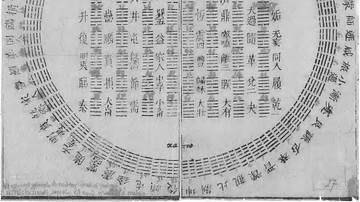
I-Ching Hexagrams
A page illustrating the various hexagrams used with the I-Ching (c. 1150-1250 BCE), or Book of Changes. This book is still available today providing a reader with interpretations for certain hexagrams which tell the future. (1701...

Video
Ching Shih: The Pirate Widow Menace of the South China Sea
You can subscribe to Highlight History here: https://www.youtube.com/channel/UCnb-VTwBHEV3gtiB9di9DZQ Source/Further reading: Historical Context: http://afe.easia.columbia.edu/timelines/china_modern_timeline.htm...

Definition
Zheng Yi Sao
Zheng Yi Sao (aka Ching Shih, Cheng I Sao, Ching Yih Saou or Mrs Cheng, d. 1844) was the chief of a massive pirate confederation which plundered the South China Sea in the early 19th century. She inherited the role from her late...

Definition
Zheng Yi
Zheng Yi (also Cheng I, Ching Yih, Cheng Yao-I, Cheng Wen-Hsien, or Cheng Yud) was a Chinese pirate who lived from 1765 to 1807. Operating in the South China Sea, Zheng Yi famously led a 600-ship pirate confederation. This force of...

Definition
Shang Dynasty
The Shang Dynasty (c. 1600-1046 BCE) was the second dynasty of China, which succeeded the Xia Dynasty (c. 2070-1600 BCE) after the overthrow of the Xia tyrant Jie by the Shang leader, Tang. Since many historians question whether...

Definition
Zhou Dynasty
The Zhou Dynasty (1046-256 BCE) was among the most culturally significant of the early Chinese dynasties and the longest lasting of any in China's history, divided into two periods: Western Zhou (1046-771 BCE) and Eastern Zhou (771-256...

Definition
Oracle Bones
Oracle Bones (also known as Dragon's Bones) were the shoulder blades of oxen or plastrons of turtles (the flat underside of the turtle's shell) which were used in the Shang Dynasty of China (c. 1600-1046 BCE) for divination. The...

Definition
Yin and Yang
The principle of Yin and Yang from Chinese philosophy is that all things exist as inseparable and contradictory opposites. Examples of Yin-Yang opposite forces are female-male, dark-light, and old-young. The pairs of equal opposites...
