
Search
Remove Ads
Advertisement
Search Results

Video
Chenonceau - The Ladies' Chateau
Not only is Le Chateau de Chenonceau one of the most magnificent palaces in France’s Loire Valley, it also has one of the most fascinating histories. It is known as the Ladies’ Chateau for the many women who owned...

Video
Penicillin: From Fleming to the Pharmacy
Penicillin's discovery by Alexander Fleming in 1929 gets a lot of hype as the advent of antibiotics. But in reality, Fleming was just one part of the story. A team from Oxford University led by Howard Florey...
Image
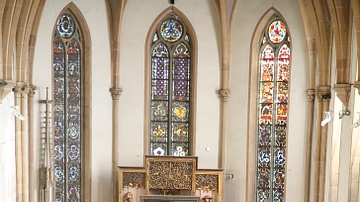
Isenheim Altarpiece
The Isenheim Altarpiece is an altarpiece sculpted and painted by, respectively, the Germans Nikolaus of Haguenau and Matthias Grünewald in 1512–1516 CE. It is on display at the Unterlinden Museum at Colmar, Alsace, in France...
Image
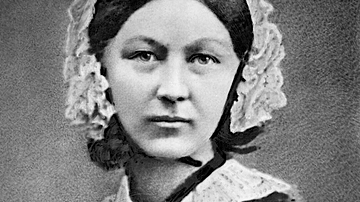
Florence Nightingale
A c. 1860 photograph of the English nurse Florence Nightingale (1820-1910) who greatly improved survival rates in military hospitals during the Crimean War (1853-56) and lobbied the British government for better facilities...
Image
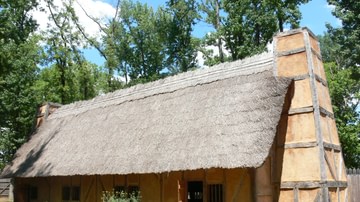
Reconstruction of Mount Malady, Henricus Colony
Reconstruction of Mount Malady, the first English hospital built in North America c. 1611 CE, at Henricus Colony of Virginia. It was destroyed in the so-called Indian Massacre of 1622 CE when the Powhatan...
Image
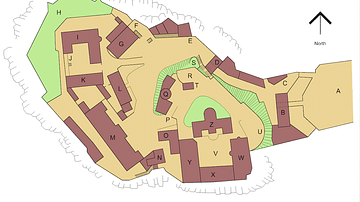
Plan of Edinburgh Castle
A plan of the buildings and layout of Edinburgh Castle, Scotland. Although occupied since the Bronze Age and site of a medieval castle from the 11th century, most of the structures today date from around 1500 with additions...

Image
The Ray House, Wilson's Creek National Battlefield
House of the Ray family at Wilson's Creek National Battlefield, photograph by J. Pinta, SW Missouri, 10 March 2014. The Ray House is one of the few remaining structures from the Battle of Wilson's...
Image
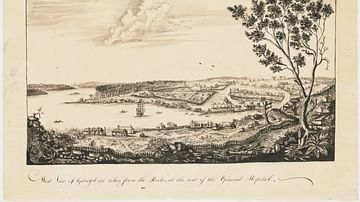
Sydney Cove 1789
West view of Sydney Cove taken from The Rocks at the rear of the General Hospital (1789).
Image
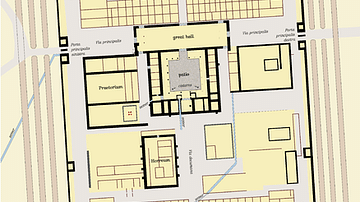
Plan of a Typical Roman Fort
A plan of the layout of a typical Roman fort. Buildings included barracks, accommodation for the commanding officer (praetorium), granaries (horrea), workshops (fabricae), a hospital (valetudinarium), a cistern, and...
