
Search
Did you mean: Tomb?
Remove Ads
Advertisement
Search Results

Image
Homo Naledi Skull
Skull of Homo naledi, who lived between 236,000 and 335,000 years ago and whose remains were found in the Rising Star Cave in South Africa. This particular skull was found in the Lesedi chamber. The scale bar represents 5 cm.
Image
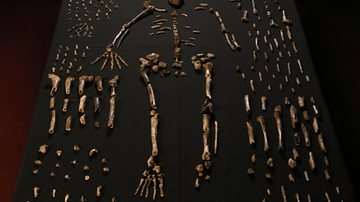
Homo Naledi Composite Skeleton
A composite skeleton that represents multiple individuals of Homo naledi, created from specimens found in the Dinaledi chamber in the Rising Star Cave, South Africa. The specimens have been dated to between 236,000 and 335,000 years old.

Image
Homo Floresiensis Skeleton
Cast of a Homo floresiensis skeleton - a species nicknamed ‘hobbit’ because it only stood about 1 meter tall. This extinct species of fossil human lived on the island of Flores, Indonesia and was first excavated there in 2003 CE at Liang...

Definition
Menehune
Menehune is the term applied to short-statured, forest-dwelling creatures of Hawaiian mythology and is part of a common mythology throughout Polynesia that describes secretive, supernatural beings with human-like attributes. Mysterious supernatural...

Image
Homo Habilis Reconstruction
Homo habilis reconstruction in the Museo de la Evolución Humana, Burgos, sculpture by Elisabeth Daynes (2010) based on the KNM-ER 1813 cranium (Koobi Fora, Kenya, dated 1.9 Ma).
Image
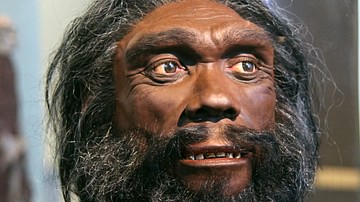
Homo Heidelbergensis Reconstruction
Reconstruction of the head of an adult male Homo heidelbergensis. It is on display in the Hall of Human Origins in the Smithsonian Museum of Natural History in Washington, D.C.

Image
Homo Sapiens & Neanderthal Skulls
Skulls of Homo sapiens (left) and Neanderthal (right) from the Cleveland Museum of Natural History. This derivative work shows the skulls from the original display on a plain black background and with the annotation removed.

Image
Homo Floresiensis Reconstruction
Reconstruction of the head of a Homo floresiensis individual, as on display at the Smithsonian's Natural Museum of Natural History in Washington, D.C.

Image
Homo Heidelbergensis & Early Neanderthal Fossil Sites
Map showing fossil sites of Homo heidelbergensis and early Neanderthals.
Image
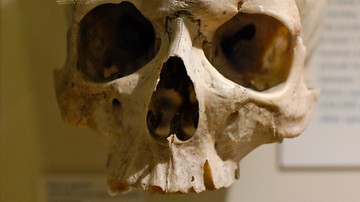
Homo Sapiens Skull
Skull of a Homo sapiens (a.k.a. modern human) individual, on display at the Harvard Museum of Natural History.
