
Search
Did you mean: Tomb?
Remove Ads
Advertisement
Search Results

Article
The Mayan Pantheon: The Many Gods of the Maya
The pantheon of the Maya is a vast collection of deities worshipped throughout the regions of Yucatan, Quintana Roo, Campeche, Tabasco, and Chiapas in Mexico and southward through Guatemala, Belize, El Salvador and Honduras. These gods informed...
Image
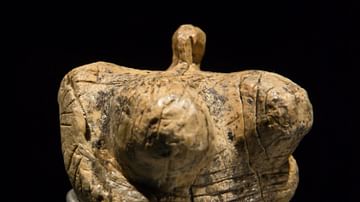
Venus of Hohle Fels
Venus from Hohle Fels, carved from mammoth ivory in the Late- or Upper Paleolithic Aurignacian period and discovered near Schelklingen, Germany. It has been dated to c. 40,000 to c. 35,000 years old.
Image
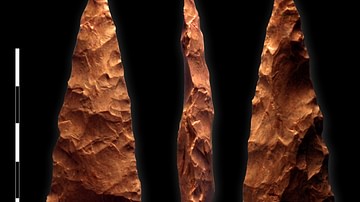
Biface from Blombos Cave, South Africa
Biface from Blombos Cave, South Africa. It belongs to the Africa Middle Stone Age (MSA) tool culture and has been dated to c. 71,000 years old.

Image
Clovis Points
Clovis points made by hunter-gatherers. These were found at the Rummells-Maske Site, 13CD15, Cedar County, Iowa, and are now part of the Iowa Office of the State Archaeologist collection.
Image
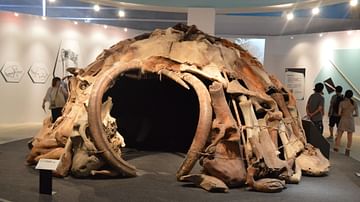
Replica of a Mammoth-bone Structure
Replica of a mammoth-bone structure, shown at the "Frozon Woolly Mammoth Yuka Exhibit" in Yokoyama, Japan in Summer 2013. Upper Palaeolithic man is known to have created dwellings using mammoth bones.
Image
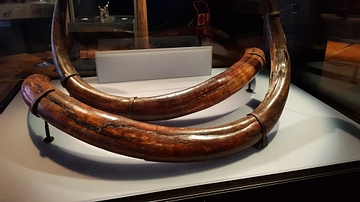
Woolly Mammoth Tusks
Tusks of a woolly mammoth found in Alaska and usually residing at the University of Alaska Museum in Fairbanks, although when (and where) this picture was taken in December 2017 it was on loan at the Australian Museum in Sydney. It came with...
Image
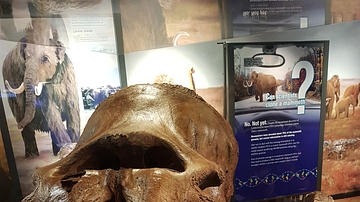
Woolly Mammoth Skull
Woolly mammoth skull, jaw, and teeth (to the right) on display at the Australian Museum in Sydney in December 2017, on loan from the University of Alaska Museum in Fairbanks where it normally resides.
Image
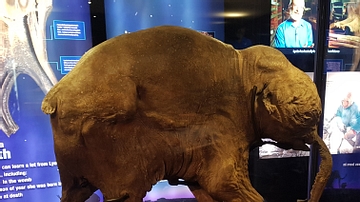
Mammoth Calf Lyuba
Remains of the woolly mammoth calf nicknamed 'Lyuba' (Russian for 'love') discovered in the Yamal peninsula in Russia in 2007. Lyuba - a female - was only about a month old at the time of her death, c. 42,000 years ago. She is the most complete...

Image
Venus of Brassempouy
The Venus of Brassempouy is one of the earliest known realistic representations of a human face. It belongs to the Gravettian culture of Upper Palaeolithic Europe and was probably carved between c. 26,000 and c. 24,000 years ago. It was made...
Image
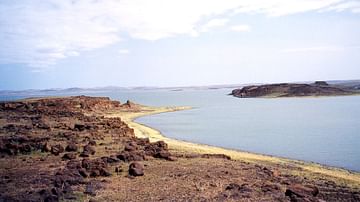
Lake Turkana, Kenya
South island of Lake Turkana in Kenya, an area in which some of the earliest hominin (i.e. human species and their immediate ancestors) fossils and tools have been found.
