
Search
Remove Ads
Advertisement
Search Results

Definition
Moses
Moses (c. 1400 BCE) is considered one of the most important religious leaders in world history. He is claimed by the religions of Judaism, Christianity, Islam, and Bahai as an important prophet of God and the founder of monotheistic belief...

Definition
Drust I
Drust I (also known as Drest I, Drest son of Irb, and Drest son of Erb) was an early king of the Picts known as "The King of One Hundred Battles" that he seems to have been victorious in. His reign is given as 406-451 CE, 413-451 CE...
Definition
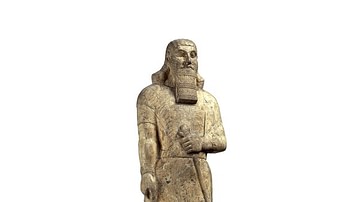
Ashurnasirpal II
Ashurnasirpal II (r. 884-859 BCE) was the third king of the Neo-Assyrian Empire. His father was Tukulti-Ninurta II (r. 891-884 BCE) whose military campaigns throughout the region provided his son with a sizeable empire and the...

Definition
Ancient Egyptian Architecture
Ancient Egyptian architecture is often associated closely with the pyramids of Giza but was actually quite diverse, taking a number of forms in the construction of administrative buildings, temples, tombs, palaces...

Definition
Assyrian Warfare
Assyria began as a small trading community centered at the ancient city of Ashur and grew to become the greatest empire in the ancient world prior to the conquests of Alexander the Great and, after him, the Roman Empire. While...

Definition
The Seven Wonders
The Seven Wonders of the Ancient World were seven impressive structures famously listed by ancient writers including Philo of Byzantium, Antipater of Sidon, Diodorus Siculus, Herodotus, Strabo, and Callimachus of Cyrene, among...

Definition
Edward Gibbon
Edward Gibbon (1737-1794) was an English historian most famous for his influential work The History of the Decline and Fall of the Roman Empire, volume one of which was published in 1776, with the final sixth volume coming in 1788...

Definition
Tiglath Pileser III
Tiglath Pileser III (745-727 BCE) was among the most powerful kings of the Neo-Assyrian Empire and, according to many scholars, the founder of the empire (as opposed to the claims for Adad Nirari II (912-891 BCE) or Ashurnasirpal...

Article
Diodorus Siculus on Fate and Philip of Macedon
Diodorus Siculus, the 1st century BCE historian, took great pride in precision of description but, even so, could not refrain from adding his own personal views and interpretations of historical events...
Interview
Interview: Queens of Jerusalem, the Women Who Dared to Rule by Katherine Pangonis
Join World History Encyclopedia as they chat with medievalist Katherine Pangonis, all about her new book Queens of Jerusalem, the Women Who Dared to Rule. Kelly: Do you want...
