
Search
Did you mean: Hera?
Search Results
Definition
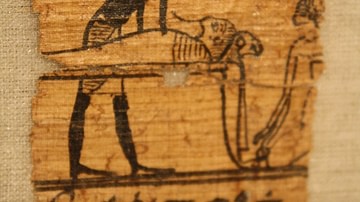
Ancient Egyptian Burial
Egyptian burial is the common term for the ancient Egyptian funerary rituals concerning death and the soul's journey to the afterlife. Eternity, according to scholar Margaret Bunson, “was the common destination of each man, woman and child...
Definition
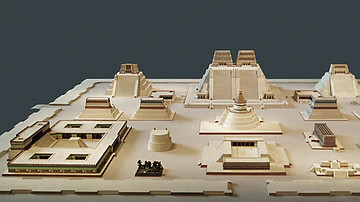
Tenochtitlan
Tenochtitlan (also spelled Tenochtitlán), located on an island near the western shore of Lake Texcoco in central Mexico, was the capital city and religious centre of the Aztec civilization. The traditional founding date of the city was 1345...

Definition
Ghosts in the Ancient World
A belief in an afterlife was central to every major civilization of the ancient world and this encouraged the recognition of the reality of ghosts as the spirits of the departed who, for one reason or another, either returned from the realm...

Article
Mummification in Ancient Egypt
The practice of mummifying the dead began in ancient Egypt c. 3500 BCE. The English word mummy comes from the Latin mumia which is derived from the Persian mum meaning 'wax' and refers to an embalmed corpse which was wax-like. The idea of...

Article
The World's Oldest Love Poem
The world's oldest love poem is The Love Song for Shu-Sin (c. 2000 BCE) composed in ancient Mesopotamia for use in part of the sacred rites of fertility. Prior to its discovery in the 19th century, and its translation in the 20th, the biblical...

Article
The Admonitions of Ipuwer - A Tale of Chaos and the Importance of Government
The Admonitions of Ipuwer (also known as The Papyrus Ipuwer and The Admonitions of an Egyptian Sage) is a literary text dated to the Middle Kingdom of Egypt (2040-1782 BCE). The only extant copy of the work, preserved on the Papyrus Leiden...
Article
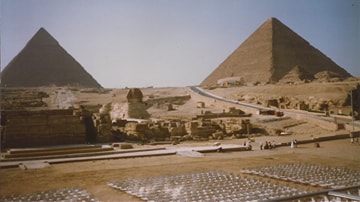
Ten Ancient Egypt Facts You Need to Know - Fun Trivia About Ancient Egypt
Ancient Egypt is defined as the civilization that flourished in North Africa between circa 6000 and 30 BCE – from the Predynastic Period in Egypt (circa 6000 to circa 3150 BCE) through the Ptolemaic Dynasty (323-30 BCE) before Egypt became...
Article
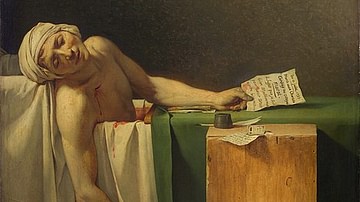
Assassination of Marat
The assassination of revolutionary activist and Jacobin leader Jean-Paul Marat on 13 July 1793 was one of the most iconic moments of the French Revolution (1789-1799), immortalized in Jacques-Louis David's painting Death of Marat. Marat's...

Article
Ashurbanipal's Collection of Sumerian and Babylonian Proverbs
Ashurbanipal's collection of Sumerian and Babylonian proverbs formed part of the famous Library of Ashurbanipal (7th century BCE) established at Nineveh for the express purpose of preserving the knowledge of the past for future generations...

Article
Hesiod on the Birth of the Gods
The Greek poet Hesiod (c. 700 BCE) is most famous for his works Theogony and Works and Days. In this passage from Theogony, Hesiod relates the birth of the gods from cosmic Chaos and follows the lineage through the great Zeus, King of the...
