
Search
Did you mean: Dacia?
Remove Ads
Advertisement
Search Results
Image
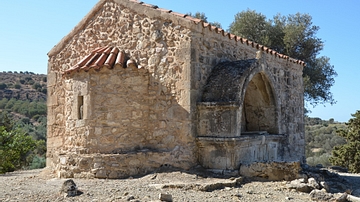
Byzantine Chapel at Hagia Triada, Crete
The Byzantine single-aisled chapel of Agios Georgios lying over the remains of a Minoan villa at the Hagia Triada archaeological site in southern Crete. The church was built during the Venetian period at the beginning of the 14th century...
Image
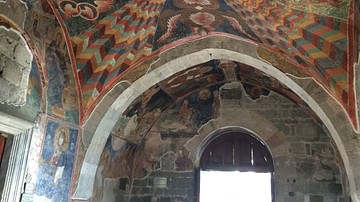
Fresco in Hagia Sophia, Trebizond
Interior fresco in the Hagia Sophia Church in Trebizond (present-day Trabzon, Turkey). 13th century CE.
Image
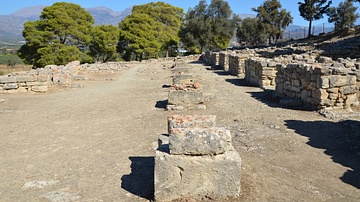
Mycenaean Agora at Hagia Triada, Crete
The Agora (marketplace) at the Minoan settlement of Hagia Triada (Crete) belonging to the Mycenaean era (1400-1100 BCE) with eight spacious rooms, probably shops, arranged behind a portico.

Image
Minoan Religious Procession on Hagia Triada Sarcophagus
Minoan limestone sarcophagus, c. 1400 BCE. Heraklion Archaeological Museum, Crete. This painting appears on one of the two longer sides of the sarcophagus. It shows a sacrificial procession, part of a funerary ritual, with a woman offering...

Video
Istanbul, Turkey: Hagia Sophia
More info about travel to Istanbul: http://www.ricksteves.com/europe/turkey/istanbul Hagia Sophia has served over the centuries as one of the greatest houses of worship in both the Christian and Muslim worlds. Hagia Sophia marks the high...
Definition
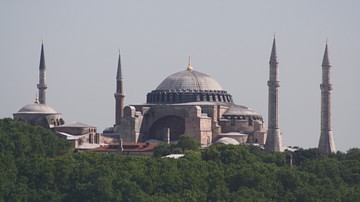
Trdat the Architect
“Trdat the Architect” or Tiridates (c. 940s-c. 1020s?) was a Armenian architect who is noted for his role in the reconstruction of the Hagia Sophia's dome in Constantinople following an earthquake in the 10th century CE, as well as the Cathedral...

Video
Nova (PBS) - Hagia Sophia, Istanbul's Mystery - 4204
How has this unique structure, built on a seismic fault, survived centuries of quakes?

Definition
Constantinople
Built in the seventh century BCE, the ancient city of Byzantium proved to be a valuable city for both the Greeks and Romans. Because it lay on the European side of the Strait of Bosporus, the Emperor Constantine understood its strategic importance...

Definition
Byzantine Empire
The Byzantine Empire existed from 330 to 1453. It is often called the Eastern Roman Empire or simply Byzantium. The Byzantine capital was founded at Constantinople by Constantine I (r. 306-337). The Byzantine Empire varied in size over the...

Definition
Byzantine Architecture
The architecture of the Byzantine Empire (4th - 15th century CE) continued its early Roman traditions but architects also added new structures to their already formidable repertoire, notably improved fortification walls and domed churches...
