
Search
Remove Ads
Advertisement
Search Results

Definition
Minotaur
In Greek mythology, the Minotaur was a monster with the body of a man and the head and tail of a bull. The Minotaur was the offspring of the Cretan Queen Pasiphae and a majestic bull. Due to the Minotaur's monstrous form, King Minos...

Definition
Nike - Greek Goddess of Victory
The ancient Greek goddess Nike was the personification of the ideal of victory. Such personifications of ideal terms were common in ancient Greek culture; other examples include Wisdom, Knowledge, and Justice. Unlike...

Definition
Phidias
Phidias (also Pheidias) was, according to his contemporaries, the most renowned of all Greek sculptors. His greatest masterpieces were completed between c. 465 and 425 BCE. Unfortunately, except through copies, no example of his work...
Definition
Rhea
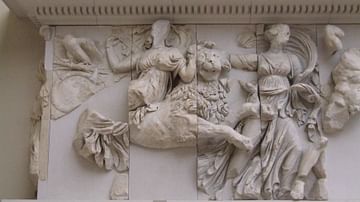
Rhea (also spelt Rheia) is a Titan and a mother goddess in Greek mythology. She is the daughter of Gaia (Earth) and Uranus (Heaven) and the mother of the great deities of Mount Olympus. Rhea was closely associated with the Phrygian (Anatolian...
Definition
Oceanus
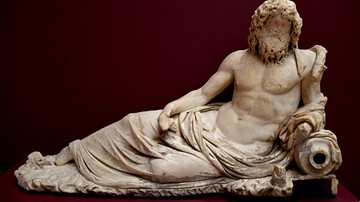
Oceanus (also Okeanos) was the eldest of the Titans and a son of Uranus (Heaven) and Gaia (Earth) in Greek mythology. He was the god and personification of the freshwater river Oceanus, which was thought to encircle the earth and was...
Definition
Thetis
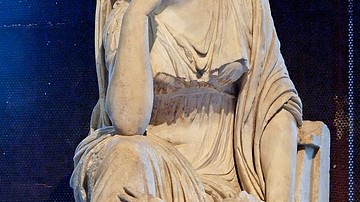
Thetis is one of 50 Nereids (sea nymphs) and a goddess of the sea in Greek mythology. Thetis is best known for being the mother of the Greek hero Achilles, however, her role goes beyond that; she appears in various stories and interacts...
Definition
Suppliants by Euripides
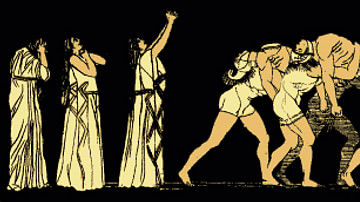
The Suppliants (also given as Suppliant Women) is a Greek tragedy written by Euripides, not to be confused with Aeschylus' tragedy of the same title. Its exact date of production is not known, possibly around 424 to 420...

Definition
Athena
Athena was the goddess of wisdom, war, and the crafts. She was the favourite daughter of Zeus and was, perhaps, the wisest, most courageous, and certainly the most resourceful of the Olympian gods. Zeus was told that his son would take...

Definition
Aeschylus
Aeschylus (c. 525 - c. 456 BCE) was one of the great writers of Greek Tragedy in 5th century BCE Classical Athens. Known as 'the father of tragedy', the playwright wrote up to 90 plays, winning with half of them at the great Athenian...

Definition
Ancient Timekeeping
The passage of time has always been a preoccupation of human beings, whether it be a question of satisfying basic needs such as when to eat and sleep, the importance of seasons for migratory and agricultural purposes or a more...
