
Search
Remove Ads
Advertisement
Search Results

Definition
Hyperborea
In Greek mythology, Hyperborea was the land located to the far north of the known world and it was so remote it was considered even beyond the North Wind. There a legendary race known as the Hyperboreans lived and worshipped the sun...

Interview
Interview: American School of Classical Studies at Athens
The American School of Classical Studies in Greece has been running its operations since the 19th century CE, with excavations across the country and an academic program that runs throughout the...
Definition
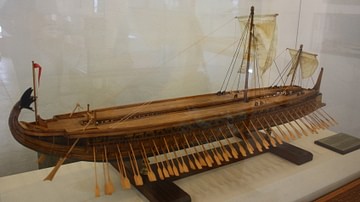
Trireme
The trireme (Greek: triērēs) was the devastating warship of the ancient Mediterranean with three banks of oars. Fast, manoeuvrable, and with a bronze-sheathed ram on the prow to sink an enemy ship, the trireme permitted Athens to build...

Definition
Medea (Play)
The tragedy Medea was written in 431 BCE by Euripides (c. 484 – 407 BCE). Euripides authored at least 90 plays of which 19 have survived intact. As with the plays by Sophocles and Aeschylus, the audience was already well aware of...

Definition
Polycrates
Polycrates (r. c. 535-522 BCE) was the tyrant of Samos who established Samian naval supremacy in the eastern Aegean and strove for control of the Aegean Sea and mainland towns of Ionia in the 6th century BCE. Polycrates had a successful...

Definition
Agamemnon (Play)
The play Agamemnon was written by one of the greatest Greek tragedians Aeschylus (c. 525 – 455 BCE), “Father of Greek Tragedy.” Older than both Sophocles and Euripides, he was the most popular and influential of all tragedians...

Article
Battle of the Nile
The Battle of the Nile (1-2 August 1798), or the Battle of Aboukir Bay, saw a British fleet led by Rear-Admiral Sir Horatio Nelson (1758-1805) destroy a French fleet at Aboukir Bay near the Rosetta mouth of the Nile River. It...

Article
The Wreck of the HMS Gloucester
The HMS Gloucester was wrecked in the North Sea, about 30 miles off the shore of Norfolk, England, shortly after dawn on 6 May 1682. It was a warship in the navy of Charles II of England (r. 1660-1685), and at the...

Definition
Hestia
Hestia was the Greek virgin goddess of the hearth, home, and hospitality. In Greek mythology, she is the eldest daughter of Cronus and Rhea. In her role as a protector of the family and political community, sacrifices and offerings were...
Definition
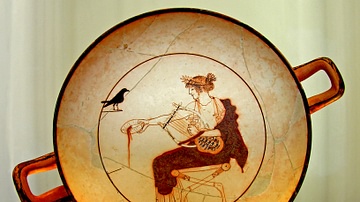
Lyre
The lyre was a stringed musical instrument played by the ancient Greeks. It was probably the most important and well-known instrument in the Greek world. The lyre was closely related to the other stringed instruments: the chelys which...
