
Search
Remove Ads
Advertisement
Search Results

Article
The Hellenistic World: The World of Alexander the Great
The Hellenistic World (from the Greek word Hellas for Greece) is the known world after the conquests of Alexander the Great and corresponds roughly with the Hellenistic Period of ancient Greece...
Article
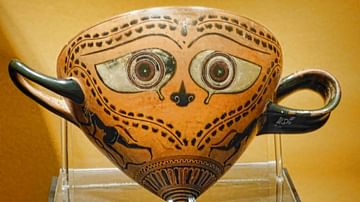
Greek Vase Painters & Potters
We know the names of some potters and painters of Greek vases because they signed their work. Generally a painter signed his name followed by some form of the verb 'painted', while a potter (or perhaps the painter writing...

Definition
Battle of Plataea
The Battle of Plataea was a land battle between Greeks and Persians near the small town of Plataea in Boeotia in 479 BCE. Following up their naval victory at the Battle of Salamis in September 480 BCE against the same enemy...

Definition
Battle of Thermopylae
Thermopylae is a mountain pass near the sea in northern Greece which was the site of several battles in antiquity, the most famous being that between Persians and Greeks in August 480 BCE. Despite being greatly inferior in...

Article
Elephants in Greek & Roman Warfare
In the search for ever more impressive and lethal weapons to shock the enemy and bring total victory the armies of ancient Greece, Carthage, and even sometimes Rome turned to the elephant. Huge, exotic, and frightening...

Definition
Satyr
Satyrs (aka silens) are figures from Greek mythology who were followers of the god of wine Dionysos. Satyrs were often guilty of excessive sexual desires and overindulgence of wine. Men with a horse's tail and ears or men with goat legs...

Article
Greek vases: names, shapes and functions
The system of names used today for Greek vases has quite rightly been described by one leading scholar as 'chaotic'. Many of the names were first applied in the eighteenth and nineteenth centuries by scholars...

Image Gallery
Gallery of Greek Temples
The architects of the ancient Greek world believed that temples should not just fulfil their purpose of housing a statue of a god or goddess but that they should be admired from both close-up and from afar. Consequently...

Definition
Roman Literature
The Roman Empire and its predecessor the Roman Republic produced an abundance of celebrated literature; poetry, comedies, dramas, histories, and philosophical tracts; the Romans avoided tragedies. Much of it survives to this day...

Video
Greek Goddess Artemis: Goddess of the Hunt and the Moon in Greek Mythology
The Greek goddess Artemis was the goddess of the hunt, wild nature and the moon in Greek mythology. She was the daughter of Leto and Zeus, and the twin sister to Apollo, the god of...
