
Search
Remove Ads
Advertisement
Search Results

Definition
Kami
In the Shinto religion kami is an all-embracing term which signifies gods, spirits, deified mortals, ancestors, natural phenomena, and supernatural powers. All of these kami can influence people's everyday lives and so they are worshipped...

Definition
Nephthys
Nephthys was one of the original five gods of ancient Egypt born of the union of Geb (earth) and Nut (sky) after the creation of the world. She was the fourth born after Osiris, Isis, and Set and was the older sister of Horus (usually...

Definition
Indra - The Vedic Religion's Greatest God
The anthropomorphic god Indra was the most important god in the Vedic religion and he later became a major figure in Hinduism and an important deity in Buddhism, Cham and Chinese tradition. For the Aryas he...

Definition
Mesopotamian Naru Literature - The World's First Historical Fiction
Mesopotamian Naru Literature was a literary genre, first appearing around the 2nd millennium BCE, which featured a famous person (usually a king) from history as the main character in a...

Definition
Thor
Thor (Old Norse: Þórr) is the Norse god of thunder, the sky, and agriculture. He is the son of Odin, chief of the gods, and Odin's consort Jord (Earth) and husband of the fertility goddess Sif, who is the mother of his son Modi and daughter...

Definition
Gutians - The Great Villains of the Sumerian Scribes
The Gutians were a West Asiatic people who are thought to have lived around the Zagros Mountains in a region referred to as Gutium. They had no written language and all that is known of them comes from...

Definition
Ancient Egyptian Culture
Ancient Egyptian culture flourished between c. 6000 BCE with the rise of technology (as evidenced in the glasswork of faience) and 30 BCE with the death of Cleopatra VII, the last Ptolemaic ruler of Egypt. It is famous...

Definition
The Negative Confession
The Negative Confession (also known as The Declaration of Innocence) is a list of 42 sins which the soul of the deceased can honestly say it has never committed when it stands in judgment in the afterlife. The soul would...

Definition
Helen (Play)
Helen is a Greek tragedy by Euripides (c. 484-407 BCE). It is usually thought to have first been performed at the Great Dionysia of 412 BCE and was part of the trilogy that included Euripides' lost Andromeda. Helen recounts an unusual...
Definition
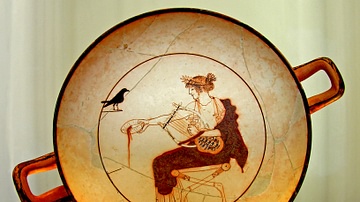
Lyre
The lyre was a stringed musical instrument played by the ancient Greeks. It was probably the most important and well-known instrument in the Greek world. The lyre was closely related to the other stringed instruments: the chelys which...
