
Search
Did you mean: Greek Fire?
Remove Ads
Advertisement
Search Results

Definition
Cyclops (Play)
The satyr-play The Cyclops was written by Euripides, one of the great Greek tragedians, in 412 or 408 BCE. Like many of his fellow tragedians, Euripides centers his play on a well-known story from Greek mythology. The Cyclops is...

Interview
Interview with Michael Levy
Join World History Encyclopedia as they talk to Michael Levy, a prolific composer of the ancient lyre all about his inspiration and knowledge of the instrument. If you want to hear Michael perform, be sure to check out...

Article
Dogs & Their Collars in Ancient Greece
Dogs in ancient Greece are regularly depicted in art, on ceramics, in literature, and other written works as loyal companions, guardians, hunters, and even as great intuitive thinkers; all of these expressing...
Definition
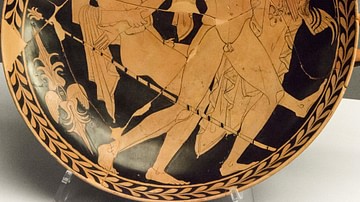
Ganymede
Ganymede (pronounced GAH-nuh-meed) is a youth in Greek mythology who is abducted by Zeus because of his great beauty and brought to Mount Olympus to serve as cupbearer. The story first appears in Homer’s Iliad without any suggestion...

Definition
The Eumenides
The Eumenides is a play written by Aeschylus (c 525 – 455 BCE), the “Father of Greek Tragedy,” the most popular and influential of all tragedians of his era. The Eumenides was the third play of a trilogy, The Oresteia, with the...

Definition
Demeter
Demeter was one of the oldest gods in the ancient Greek pantheon. Demeter was a goddess of agriculture and guaranteed the fertility of the earth. She protected both farming and vegetation. The close connection with the earth was inherited...
Definition
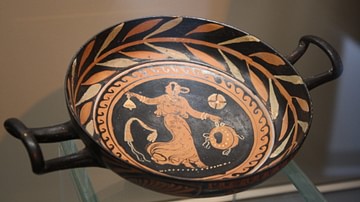
Bacchae
The Bacchae is a Greek tragedy written by the playwright Euripides (c. 484-406 BCE) in 407 BCE, which portrays Pentheus as an impious king, for the ruler of Thebes has denied the worship of Dionysus within his city walls. For Pentheus...

Definition
Hephaistos
Hephaistos (Hephaestus) was the ancient Greek god of fire, metallurgy, and crafts. He was the brilliant blacksmith of the Olympian gods, for whom he fashioned magnificent houses, armour, and ingenious devices. Hephaistos had his workshop...

Definition
Selene
Selene (also known as Mene) is the personification and goddess of the moon in Greek mythology. Every night, she travels across the sky in her chariot, pulling the moon behind her. Selene is the daughter of the Titans Hyperion and Theia...

Definition
Battle of the Granicus
The Battle of the Granicus in May 334 BCE was Alexander the Great's (356-323 BCE) first major victory against the forces of the Achaemenid Empire. Alexander had crossed the Hellespont with his combined Macedonian and Greek...
