
Search
Did you mean: Freyr?
Remove Ads
Advertisement
Search Results

Definition
Hellenistic Astrology
Hellenistic astrology encompassed various forms of divination in Greece and the Mediterranean, all linked to the observation of astronomical phenomena. Hellenistic astrology was based on the belief that the stars and planets could either...

Definition
Fayum
The Faiyum (also given as Fayoum, Fayum, and Faiyum Oasis) was a region of ancient Egypt known for its fertility and the abundance of plant and animal life. Located 62 miles (100 kilometers) south of Memphis (modern Cairo), the Faiyum was...

Definition
Temple of Garni
The Temple of Garni (Armenian: “Garnu tacar”) is located in the village of Garni in Kotayk Province, Armenia, and it was once a pagan temple dedicated to the Armenian sun god Mihr. Built in the middle of the 1st century CE, the Temple of...
Definition
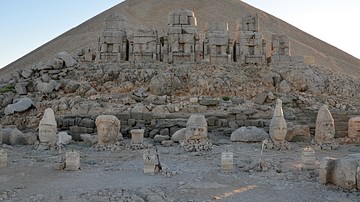
Commagene
The Kingdom of Commagene (163 BCE - 72 CE) was a Hellenistic political entity, heavily influenced by Armenian and ancient Persian culture and traditions, established in southwestern Anatolia (modern-day Turkey) by Ptolemaeus of Commagene...
Definition
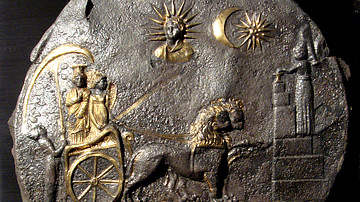
Eucratid
The Eucratids were a Greco-Bactrian and Indo-Greek dynasty of approximately 12 kings, lasting between c.171 BC and 80-70 BC, according to numismatic evidence. The numismatic emblem which characterized it were the palm and the Dioscuri (Castor...
Definition
Eucratidia
Eucratidia was a Greek town in Bactria, one of the easternmost area ever controlled by the Greeks, located at the modern site of Aï Khanum in North-Eastern Afghanistan. The history of this city is still rather unknown, but it seems that...
Definition
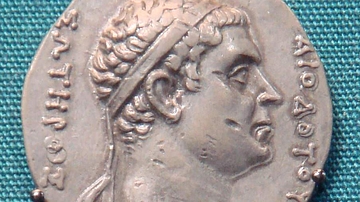
Diotid Dynasty
The Diodotids were a Greco-Bactrian dynasty of kings, composed of the two rulers Diodotos I and his son Diodotos II. The dynasty lasted between c. 250 BCE and c. 230 BCE, which was very short but significant because Diodotos I was the first...
Image
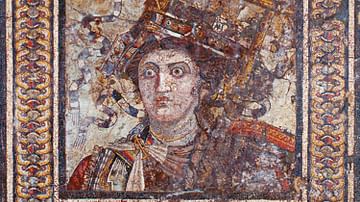
Mosaic Portrait of Berenice II
Mosaic with square emblem depicting Berenice II as personification of naval prowess (Thmouis, ca. 245-200 BCE; Greco-Roman Museum, Alexandria, inv. 21.739). Photograph by A. Pelle © Centre d’Études Alexandrines/CNRS, courtesy of Jean-Yves...

Article
The Origin of Satan
Satan, or the Devil, is one of the best-known characters in the Western traditions of Judaism, Christianity, and Islam. Surprisingly, this entity was a late-comer in the ancient world. Satan, as a totally evil being, is nowhere to be found...

Article
Sacred Sites & Rituals in the Ancient Celtic Religion
In the religion of the ancient Celts who lived in Iron Age Europe from 700 BCE to 400 CE, certain natural sites like springs, river sources, and groves were held as sacred. These places, as well as some urban sites, often had purpose-built...
