
Search
Remove Ads
Advertisement
Search Results

Article
Trade in Medieval Europe
Trade and commerce in the medieval world developed to such an extent that even relatively small communities had access to weekly markets and, perhaps a day's travel away, larger but less frequent fairs, where the full range...
Article
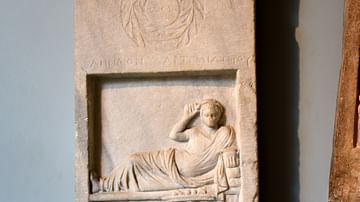
Curses & Fines on Epitaphs
The concept of a curse laid on a tomb or gravesite is best known from ancient Egypt but the practice was quite common in other civilizations of antiquity. The tomb or grave was the eternal home of the physical remains...

Article
Paul's Journeys and the Mediterranean Trade
Mediterranean trade increased exponentially at the turn of the first millennium. During Rome's zenith, goods of all sorts began to move in all directions. As a common traveler aboard merchant ships, Paul...

Article
Caesarea Maritima's Role in the Mediterranean Trade
Caesarea Maritima was located on the eastern coast of the Mediterranean Sea. Built from the ground up in 22-10 BCE by Rome's client king, Herod the Great (r. 37-4 BCE), its location in relation to ship...

Article
Burial in Ancient Mesopotamia - Respect for the Living, Honoring the Dead
Burial in ancient Mesopotamia was the practice of interring a corpse in a grave or tomb while observing certain rites, primarily to ensure the passage of the soul of the deceased to...

Definition
Lend-Lease - The WWII US Aid Programme for Allies
Lend-Lease (sometimes called Lease-Lend) was a programme of financial and material aid given by the United States to its allies during the Second World War (1939-45). Food, weapons, ammunition, and agricultural...
Article
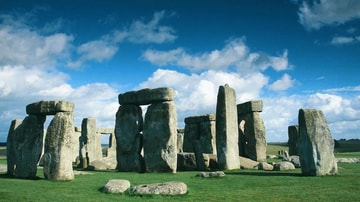
The Stonehenge Burials
A great deal has been written about why the prehistoric monument of Stonehenge, in Wiltshire, southern England, was constructed. Perhaps it was designed as a temple to the ancestors, an astronomical calendar, a healing centre...

Article
Trade in the Roman World
Regional, inter-regional and international trade was a common feature of the Roman world. A mix of state control and a free market approach ensured goods produced in one location could be exported far and wide. Cereals...

Image
Recreation of Vix Grave
A recreation of the "Grave of the Lady of Vix", from the Museum of Pays Châtillonnais - Trésor de Vix, in France. The "Vix Grave" was an inhumation burial from around 500 BCE, in which a young woman of high social status...
Image
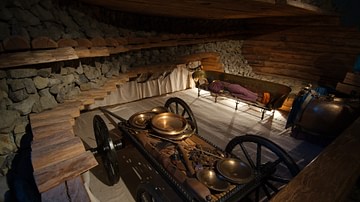
Reconstruction of the Hochdorf Chieftain's Grave
A reconstruction of an Iron Age grave from Hochdorf an der Enz in Baden-Württemberg, Germany. This burial mound is associated with the Hallstatt Culture, and the man interred is believed to have been...
