
Search
Did you mean: God's Wife of Amun?
Remove Ads
Advertisement
Search Results

Definition
Enki - The Tricky Sumerian God of Wisdom
Enki (also known as Ea, Enkig, Dis, Nagbu, Nissiku Nudimmud) was the Sumerian god of wisdom, freshwater, intelligence, trickery and mischief, crafts, magic, exorcism, healing, creation, virility, fertility, and art. Iconography depicts him...

Definition
Enlil - Mesopotamian Keeper of the Tablets of Destiny
Enlil (also known as Ellil and Nunamnir) was the Sumerian god of the air in the Mesopotamian pantheon, but he was more powerful than any other elemental deity and eventually was worshiped as King of the Gods. He is featured in a number of...
Image
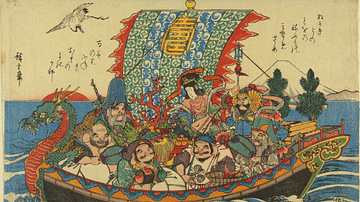
Seven Lucky Gods on Takarabune
The Seven Lucky Gods (aka Shichifukujin) of Japanese folklore on their treasure ship or takarabune. By Hiroshige (1797-1858 CE). Woodblock print, c. 1840 CE. (Victoria & Albert Museum, London)
Image
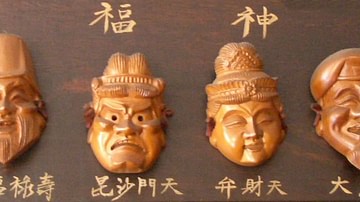
Seven Lucky Gods
The Seven Lucky Gods or Shichifukujin of Japanese folklore. From left to right: Soldan Sağa Hotei, Juroujin, Fukurokuju, Bishamonten, Benzaiten, Daikokuten, Ebisu
Image
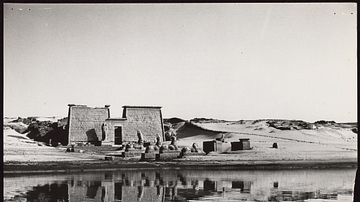
Temple of Amun Ra and Ra Harmakhis
This temple was constructed in the Valley of the Lions by Ramesses II (c. 1250 BCE) in honour of the gods Amun Ra and Ra Harmakhis. The back of the temple is hollowed out in the rock. In the foreground stands the king's statue and a "dromos"...
Image
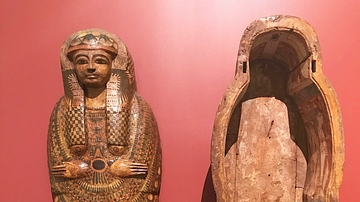
Coffin of the Chantress of Amun
This is the coffin of the "Chantress of Amun," and it dates c. 1070-945 BCE or Egypt's Third Intermediate Period (c. 1070-712 BCE). It is made of wood with a painted gesso relief. Ancient Egyptian coffins sheltered remains and provided a...
Image
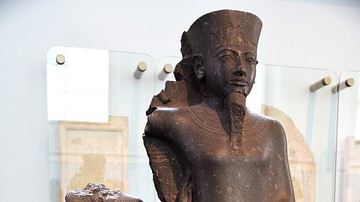
King Horemheb with Amun-Ra
King Horemheb with Amun-Ra, probably from the temple of Amun-Ra at Thebes, Karnak, possibly usurped from Tutankhamun (c. 1336-1327 BCE), 18th Dynasty, c. 1323-1295 BCE. The inscriptions identify the headless king as Horemheb and the larger...

Image
Temple of Amun Plan, Karnak
A plan of the Temple of Amun and other temples at Karnak, Thebes. c. 1312–1235 BCE.

Image
Amun, Mut, and Khonsu
Three standing-striding divine bronze figures from ancient Egypt. This divine triad represents the god Amun, who wears the feathered crown (behind), the goddess Mut (right), and the god Khonsu (as a child). Late Period of Ancient Egypt, 25th-26th...

Image
Temple of Amun, Karnak
The first courtyard of the Temple of Amun, Karnak. It measures 84 x 99 metres and was built during the 22nd Dynasty rule of Sheshonk I (Shoshenq I).
