
Search
Did you mean: God's Wife of Amun?
Remove Ads
Advertisement
Search Results

Definition
The Candaces of Meroe
The Candaces of Meroe were the queens of the Kingdom of Kush who ruled from the city of Meroe c. 284 BCE-c. 314 CE - a number of whom ruled independently c. 170 BCE-c. 314 CE - in what is now Sudan. The title Candace is the Latinized version...

Definition
Ancient Egyptian Architecture
Ancient Egyptian architecture is often associated closely with the pyramids of Giza but was actually quite diverse, taking a number of forms in the construction of administrative buildings, temples, tombs, palaces, and the private homes of...

Collection
The 12 Olympian Gods
The 12 gods of Mount Olympus were the most important deities in ancient Greece. In this collection, we examine each of the 12 in detail. With their all-too-human qualities in Greek mythology, the Olympian gods were capable of displaying great...

Definition
Tutankhamun
Tutankhamun (also known as Tutankhamen and `King Tut', r. c.1336-c.1327 BCE) is the most famous and instantly recognizable Pharaoh in the modern world. His golden sarcophagus is now a symbol almost synonymous with Egypt. His name means `living...

Definition
Ergamenes
King Ergamenes (also known as King Arkamani I, r. 295-275 BCE) was the greatest king of the city of Meroe, Kingdom of Kush (located in modern-day Sudan) who broke free from Egyptian dominance to help direct a wholly distinct culture. The...
Article
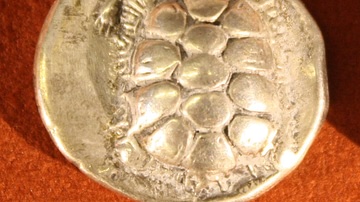
The Island Kingdom of Aegina: The Old Gods Still Whisper Their Truths
Today, traveling an hour by ferry from Piraeus, the port of Athens, the first remnant of Aegina's great past a visitor will see is the lonely pillar of Apollo rising from the trees on the hill of Kolona. Once a splendid complex of three buildings...

Image
Amun, Ramesses II, & Mut
A granite monument depicting the god Amun, Ramesses II, and the goddess Mut. Dynasty XIX, 1279-1213 BCE. Temple of Amun, Thebes. (Egyptian Museum, Turin, Italy)

Image
Amun & Tutankhamun
A limestone sculpture depicting the god Amun (larger) and Tutankhamun, from the Temple of Amun, Thebes, 18th Dynasty, 1333-1323 BCE.
Egyptian Museum, Turin.
Collection
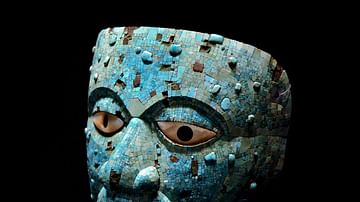
15 Aztec Gods
The Aztecs of northern Mesoamerica (c. 1345 and 1521 CE) worshipped some of the weirdest, most fantastic and downright scary gods seen anywhere in history. The Aztec civilization and the empire it created revolved around winning special favour...

Image
The Seven Lucky Gods of Japan - Seven Deities, Countless Blessings
The Seven Lucky Gods of Japan (Shichifukujin) are a group of deities associated with prosperity, happiness, and longevity. Blending Shinto, Buddhist, Taoist, and even Hindu influences, they came together as a collective pantheon during Japan’s...
