
Search
Did you mean: Germanicus?
Remove Ads
Advertisement
Search Results
Image
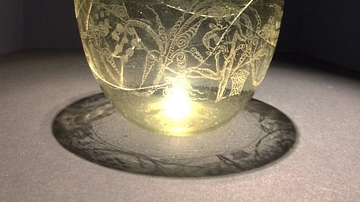
A Roman Beaker for Merueifa
A dedication is incised on the rim of this Roman beaker made of glass: "MERVEIFA VIVAS TVIS." (Translation from Latin: "Merueifa, may you live among your own.") Beneath the inscription are naked, winged boys harvesting...
Image
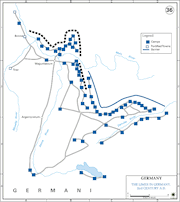
The Limes in Germany
A map of Roman limes, located outside the city of Trier, in present-day Germany.
Image
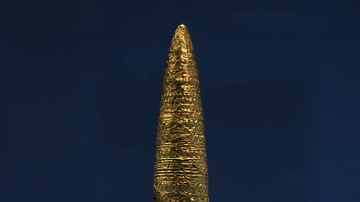
Gold Cone of Ezelsdorf-Buch
The Gold Cone of Ezelsdorf-Buch is a tall (88 cm), cone-shaped object made of thin sheet gold, it is seen as belonging to a group of artifacts referred to as Bronze Age Golden hats. It was presumably worn by special functionaries...
Article
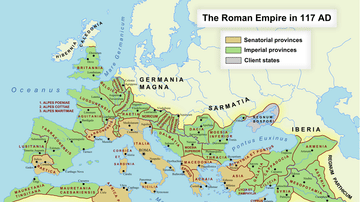
The Extent of the Roman Empire
Time has seen the rise and fall of a number of great empires - the Babylonian, the Assyrian, the Egyptian, and lastly, the Persian. Regardless of the size or skill of their army or the capabilities of their leaders...

Article
Sulla's March on Rome
In 88 BCE, Lucius Cornelius Sulla (138-78 BCE) marched on Rome and entered the city's sacred inner boundary, the pomerium, bearing arms. Breaking this taboo, he sought to gain political power and control of the army of the...
Article
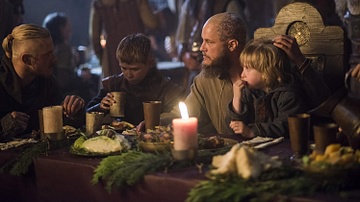
Norse-Viking Diet
In many depictions of Vikings, whether in film or other media, a group is often seen gathered around a flaming pit while an animal of some type – usually a boar – turns on a spit above. While the people of Scandinavia certainly...

Article
The Sun & the Moon in Norse Myth
In Norse mythology, the Sun and the Moon appear as personified siblings pulling the heavenly bodies and chased by wolves, or as plain objects. Written sources, such as the Poetic Edda and the Prose Edda, have surprisingly...

Article
Hadrian's Travels
No other Roman emperor travelled as much as Hadrian (r. 117-138 CE). The 'restless' emperor spent more time travelling than in Rome, devoting half of his 21-year reign to the inspection of the provinces. His travels provided...

Article
Tacitus' Account of The Battle of Mons Graupius
The Battle of Mons Graupius was fought in 83 CE between the invading forces of Rome, under the general Agricola, and the Picts, the indigenous people of modern-day Scotland, under their leader Calgacus...

Article
Marcus Aurelius: Plato's Philosopher King
Plato's concept of the Philosopher-King (one who governs according to philosophical precepts and higher truths) is thought to be best exemplified through the Roman emperor Marcus Aurelius Antoninus (r. 161-180...
