
Search
Did you mean: Germanicus?
Remove Ads
Advertisement
Search Results

Definition
Ptolemy of Mauretania
Ptolemy of Mauretania (r. 23-40 CE) was king of Mauretania and one of the last surviving members of the Ptolemaic dynasty. His father Juba II (c. 48 BCE to 23 CE) was a Numidian royal and his mother Cleopatra Selene II (40...

Definition
Publius Quinctilius Varus
Publius Quinctilius Varus (c. 46 BCE – 9 CE) was a Roman politician and general under the rule of Emperor Augustus. He is most remembered for having lost three Roman legions when ambushed by Germanic tribes in the battle...

Definition
Gallienus
Gallienus was Roman emperor from 253 to 268 CE. Publius Licinius Egnatius Gallienus, the eldest son of Emperor Valerian, was named co-emperor by his father in 253 CE. He was one of many who would claim the throne over the next two...
Definition
Legio V Alaudae
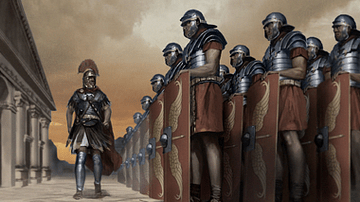
Legio V Alaudae, referenced in early accounts only as the "Fifth", was one of the many legions of the Roman army that helped Julius Caesar (100-44 BCE) to achieve success as a military commander in Gaul, Spain, and Africa. Later...
Definition
Augusta Raurica
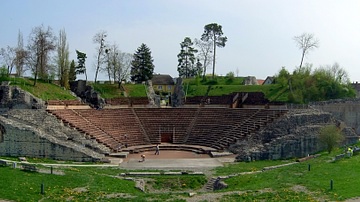
Augusta Raurica is a former Roman colony and city located on the Rhine River some 11 km (7 miles) east of the modern Swiss city of Basel, in between the towns of Kaiseraugst and Augst. Founded by Lucius Munatius Plancus (90 BCE...

Image
Map of Roman Gaul from Conquest to Integration, c. 200 CE - Provincial Order and Frontier Power in the Roman West
The Roman incorporation of Gaul began with the campaigns of Julius Caesar (58–51 BCE) and resulted in the gradual transformation of a diverse Celtic...

Article
Legions of Pannonia
Located west of the Danube, Pannonia was essential for the protection of the Roman Empire's eastern frontier. It had been occupied since 9 BCE but did not willingly accept Roman authority. Pannonia and Dalmatia revolted in...

Article
Legions of the Rhine Frontier
After Julius Caesar’s (100-44 BCE) conquest of Gaul, Roman legions pushed the borders of the Roman Empire’s frontier to the banks of the Rhine River. Augustus (r. 27 BCE - 14 CE) divided the newly acquired region into...

Article
Beer in the Ancient World - The Drink of the Gods - For Some
The intoxicant known in English as beer takes its name from the Latin bibere (by way of the German bier), meaning "to drink", and the Spanish word for beer, cerveza, comes from the Latin word...

Article
The Battle of Colmar (58 BCE): Caesar against Ariovistus
The Battle of Colmar (58 BCE): one of the first battles of the Gallic War, in which Caesar defeated an army led by the Germanic leader Ariovistus. In 58 BCE, Julius Caesar had invaded Central Gaul...
