
Search
Remove Ads
Advertisement
Search Results
Image
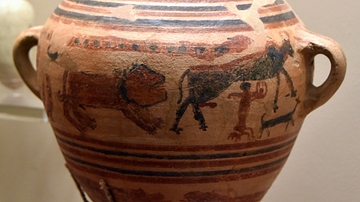
Pottery Jar Showing a Myth from Tell Zar'a
Lare jar painted in red and black on beige. The paintings show animal scenes in two registers. In the lower register, two large snakes lie opposite each other. In the upper one, framed by horizontal lines...

Image
Pottery from Shengavit
Many potsherds have been discovered at the Shengavit settlement and archaeological site in Armenia (c. 3500-2200 BCE). (Shengavit Museum, Yerevan).

Image
Painted Pottery Shabti-Jar
From Abydos, Egypt. 19th to 20th Dynasties, circa 1295-1070 BCE. (The British Museum, London)

Image
Glazed Pottery Bottle from Babylon
The bottle is completely intact and has a rough glaze. From Babylon, Mesopotamia, Iraq. Neo-Babylonian period, 626-539 BCE. (The British Museum, London)
Image
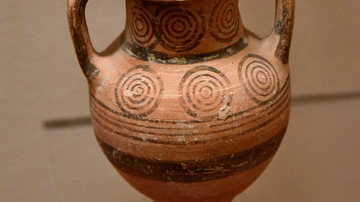
Cypro-Phoenician Pottery Vessel
This vessel belongs to a ceramic tradition known as "black-on-red" ware, the most ubiquitous of the Iron Age's Cypro-Phoenician exports. Iron Age II, 1000-539 BCE. From Amman, Jordan. (The Jordan Museum, Amman, Jordan...

Image
Moche Pottery Portrait
From the Apogee Epoch (c. 1 CE - 800 CE). Housed at the Museo Larco, Lima, Peru
Image
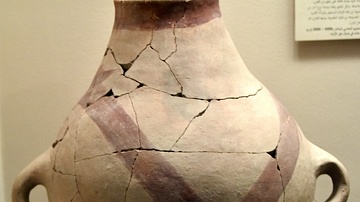
Decorated Pottery Jar from Abu Hamid
This type is similar to the ones used for infant burials, but this one is painted with red strips using iron oxide (hematite), material already known during the Neolithic period for coloring plaster. The Jar was...

Image
Pottery Ossuary from Azor
Chests of this sort were used to contain the bones of individuals in secondary burials. These were burials in which the body had been exposed and allowed to decay before the bones were gathered. At Azor, on the coast of...

Image
Pottery Jug from Ancient Cyprus
This jug of bichrome ware was found in Cyprus. Cypro-Archaic 600-480 BCE. (National Museum of Ireland-Archaeology, Dublin, Republic of Ireland)
Image
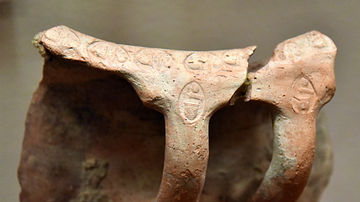
Stamped Pottery Jar from Tell al-Khulayfi
An oval seal impression repeated on the rim and handles of a large jar. Seal impressions are official guarantees of the jars and their contents; therefore, stamped jars indicated the presence of a local administrative...
