
Search
Remove Ads
Advertisement
Search Results

Article
Day of the Dead
The Day of the Dead, known in Spanish as Día de los Muertos, is a holiday that celebrates life and honors the dead through traditions, food, decorations, and activities intended to sustain the connections between the living and...

Article
Cortés & the Fall of the Aztec Empire
The Aztec empire flourished between c. 1345 and 1521 CE and dominated ancient Mesoamerica. This young and warlike nation was highly successful in spreading its reach and gaining fabulous wealth, but then all too...

Article
The History of the Inquisition - The Catholic Church's Battle Against Deviance
The Inquisition was the official institution of the medieval Catholic Church that established ecclesiastical judges to investigate and judge divergent opinions and practices that...

Article
Cibola - The Seven Cities of Gold & Coronado
The Seven Cities of Cibola are the mythical lands of gold that the Spanish of the 16th century believed existed somewhere in the southwest of North America, comparable to the better-known mythical city of...

Article
The Portuguese Colonization of Madeira
Madeira is a group of volcanic islands in the North Atlantic which were colonised by the Portuguese from 1420. The settlement and distribution of land rights on the uninhabited islands was a model the Portuguese...

Article
European Discovery & Conquest of Sri Lanka
The island of Sri Lanka (formerly known as Ceylon) became a focus of European attention soon after the Portuguese entry into the Indian Ocean in the late 15th century. Large swaths of the island would come...
Article
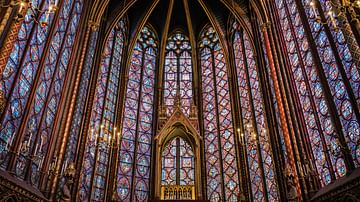
Louis IX and Capetian Politics at Paris' Sainte-Chapelle
The Sainte-Chapelle in Paris was originally consecrated as a private royal chapel in 1248 during the reign of King Louis IX of France (r. 1226-1270), who was known in life as rex christianissimus...

Article
Cliffs, Caves, Churches: A Weekend in Doolin, Ireland
County Clare, Ireland, is best known for the Cliffs of Moher, the ancient dolmen of Poulnabrone, and its rich musical heritage, but it offers many other fascinating sites and, most importantly, the...
Image
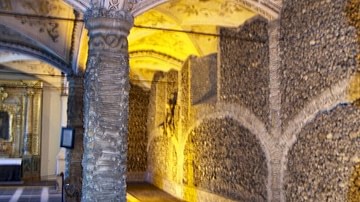
Capela dos Ossos (The Chapel of Bones)
Capela dos Ossos (The Chapel of Bones) attached to the Igreja de São Francisco, Evora, Portugal. The Chapel of Bones was constructed by Franciscan monks in the late 16th century CE. Photo taken 2009 CE.

Image
Capela dos Ossos, Evora, Portugal
Inscription above the door to Capela dos Ossos (Chapel of Bones), Evora, Portugal. The Chapel of Bones was constructed by Franciscan monks in the late 16th century CE. Photo taken 2017 CE.
