
Search
Remove Ads
Advertisement
Search Results

Article
Battles of Saratoga
The Battles of Saratoga (19 September and 7 October 1777) marked the climactic end of the Saratoga Campaign during the American Revolutionary War (1775-1783). The battles, which resulted in the surrender of an entire British...

Article
Herod's Harbor
Herod's Harbor was a giant port built between 22 and 15 BCE by Herod the Great (r. 37-4 BCE), Rome's client king. Situated on the lower eastern Mediterranean coast north of Alexandria and south of Tyre, with Rome's largess and...

Article
Battle of Fort Washington
The Battle of Fort Washington (16 November 1776) took place during the American Revolutionary War (1775-1783) as part of the British effort to seize control of Manhattan Island. It saw a British and Hessian force capture...

Article
Archaeological Excavations at Tel Kabri
Tel Kabri is an archaeological site in northwestern Israel that is best known as the location of one of the largest palaces in Canaan in the Middle Bronze Age or "MB" (ca. 2,000–1,500 BCE). Although Tel Kabri...
Article
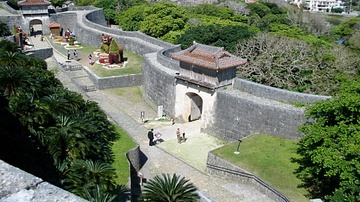
The Ryukyu Castles of Okinawa
The medieval Ryukyu castles on the island of Okinawa, Japan are impressive testimony to the kingdom's power and wealth from the 12th to 16th century. Notable castles include Shuri Castle, the royal residence, and four...

Image
Piraeus & The Long Walls
An illustration of the Long Walls fortifications which connected the city of Athens to its port of Piraeus from the 5th century BCE.
Image
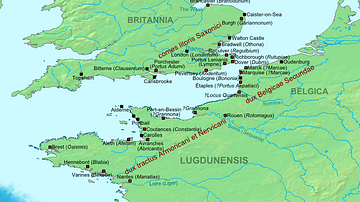
Map of the Saxon Shore, c. 380 CE
The Late Roman fortifications of the "Saxon Shore" (litus Saxonicum) in Britain and France.
Image
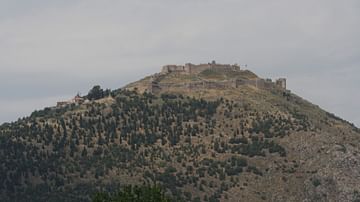
Acropolis of Argos
The Hill of Larissa, site of the ancient acropolis of Argos (6th to 5th century BCE). Visible today are the fortifications of the 10th century CE which incorporated some of the ancient polygonal walls, particularly on the north...
Image
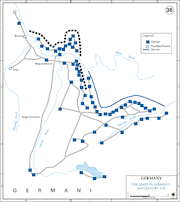
The Limes in Germany
A map of Roman limes, located outside the city of Trier, in present-day Germany.
Image
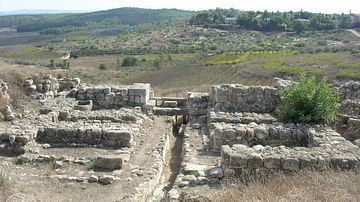
Six-Chambered Gate at Tel Gezer
The six-chambered gate at Tel Gezer in modern-day Israel. This Iron Age gate was once thought built by King Solomon, however recent scholarship has cast doubt on this idea, with some scientific evidence pointing to...
