
Search
Remove Ads
Advertisement
Search Results

Article
The Five Gifts of Hathor: Gratitude in Ancient Egypt
The central cultural value of ancient Egypt was ma'at – harmony and balance – which maintained the order of the universe and the lives of the people. Keeping balance in one's life encouraged the same...

Definition
Ancient Egypt - The Land of the Gods of Balance and Harmony
Egypt is a country in North Africa, on the Mediterranean Sea, and is home to one of the oldest civilizations on Earth. The name "Egypt" comes from the Greek Aegyptos, which was the Greek pronunciation...

Definition
New Kingdom of Egypt - The Age of Empire
The New Kingdom (circa 1570 to circa 1069 BCE) is the era in Egyptian history following the disunity of the Second Intermediate Period (circa 1782-1570 BCE) and preceding the dissolution of the central government...

Definition
Pharaoh
The Pharaoh in ancient Egypt was the political and religious leader of the people and held the titles 'Lord of the Two Lands' and 'High Priest of Every Temple'. The word 'pharaoh' is the Greek form of the Egyptian pero or per-a-a, which...

Definition
Apophis
Apophis (also known as Apep) is the Great Serpent, enemy of the sun god Ra, in ancient Egyptian religion. The sun was Ra's great barge which sailed through the sky from dawn to dusk and then descended into the underworld. As it sailed...

Definition
Hyksos - The Rulers of Foreign Lands Who Transformed Egypt
The Hyksos were a West Semitic-speaking people who gained a foothold in Egypt circa 1782 BCE at the city of Avaris in Lower Egypt, thus initiating the era known in Egyptian history as the Second...

Definition
Caesarion
Ptolemy XV Caesar “Theos Philopator Philometor” (“the Father-loving Mother-loving God”) (c. 47-30 BCE), better known by his unofficial nickname Caesarion or “Little Caesar” in Greek, was the oldest son of Cleopatra VII (69-30 BCE...

Definition
Typhon
Typhon (also Typheus) is the largest and most dreadful monster in Greek mythology. He was tall, with a brutish face, and had wings, countless snakeheads in place of hands, and a lower body made up of coiled serpents. His eyes flashed...

Definition
Bes
Bes is the ancient Egyptian god of childbirth, fertility, sexuality, humor, and war, but served primarily as a protector god of pregnant women and children. He is regularly depicted as a dwarf with large ears, long-haired and bearded, with...
Definition
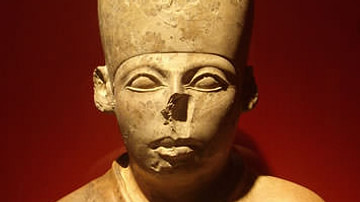
Second Dynasty of Egypt
The Second Dynasty of Egypt (c. 2890 - c. 2670 BCE) rose from the turmoil which ended the first and was marked by uprisings (or, at least, internal difficulties) throughout. The precise cause of this civil unrest is unclear...
