
Search
Remove Ads
Advertisement
Search Results
Image
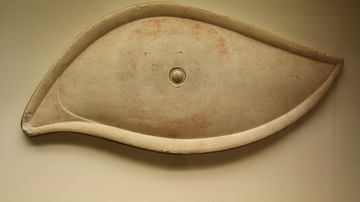
Trireme Eye
A marble eye which was once attached to the prow of a trireme in order to ward off evil. Traces of the original paint can still be seen. (Archaeological Museum of Piraeus)
Image
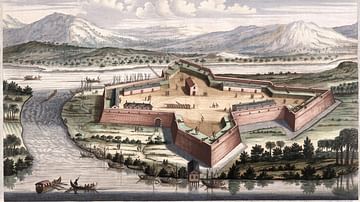
Bird's Eye View of the Fort of Batticaloa
Bird's eye view of the fort of Batticaloa, copperplate printing on paper by Johannes Janssonius Waasbergen, c. 1665.
Nationaal Archief, The Hague.

Image
The Builder’s Eye - Viking Ship Construction 20
The Viking building tradition relied more on the shipbuilder’s eye than on an obsession with rulers. Correct proportions were established through memory and experience carried into the hand. Charcoal illustration...
Image
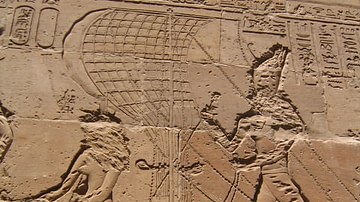
Set Defeated by Horus
Set defeated by Horus as depicted in the Ptolemaic Period Temple of Horus at Edfu.
Image
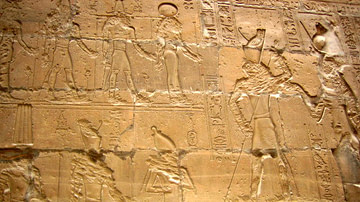
Temple of Horus, Edfu
A scene depicting Horus' victory over Set from the Temple of Horus at Edfu, built in the Ptolemaic Period.
Image
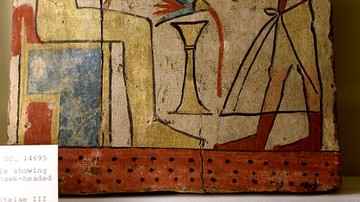
Stela of Ihefy & Horus
This painted wooden stela depicts a man (his name is identified as Ihefy and his title was "the doorkeeper of the house of Amun") adoring the hawk-headed god Horus. Horus sits on a throne and holds a flail. There is a red...

Image
Horus Bird Statuette
Small statue of Horus.
Staatliches Museum Ägyptischer Kunst (State Museum of Egyptian Art), Munich.
Image
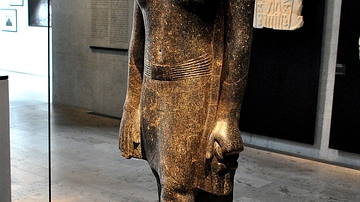
Statue of Horus
Standing-striding granodiorite statue of the god Horus, from the mortuary temple of Amenophis III, Western Thebes, New Kingdom of Egypt, 18th Dynasty, c. 1360 BCE.
State Museum of Egyptian Art, Munich, Germany.
Image
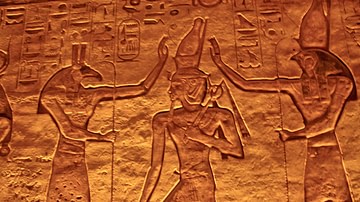
Set and Horus Blessing Ramesses II
Scene from the Temple of Hathor (Abu Simbel, Egypt), built during the reign of Ramesses II, c. 1264-1224 BCE. Set and Horus blessing Ramesses II.

Image
Horus Statuette
In this silver statue, Horus wearing the double crown. Egypt, 27th Dynasty, circa 500 BCE. (State Museum of Egyptian Art, Munich, Germany).
