
Search
Remove Ads
Advertisement
Search Results

Article
Sargon and Ur-Zababa - Two Dream Visions and a River of Blood
Sargon and Ur-Zababa is a Sumerian poem, date of composition unknown, relating the rise to power of Sargon of Akkad (reign 2334-2279 BCE), founder of the Akkadian Empire. The work is classified...

Article
Herodotus on Babylon
The description of Babylon and Babylonian customs in Histories by the Greek historian Herodotus (l. c. 484-425/413 BCE) has long been challenged for accuracy and been found wanting, leading some scholars to dismiss the work...

Article
Setna II: A Detailed Summary & Commentary
Setna II (also Setna Khaemaus and Si-Osire) is a work of ancient Egyptian literature from Roman Egypt (30 BCE - 646 CE) written in demotic script. It is part of a cycle of stories known as the Tales of Prince...

Article
Mesopotamian Inventions - Creating the Future
Mesopotamian inventions include many items taken for granted today, most of which were created during the Early Dynastic period (circa 2900-2350/2334 BCE) or developed from achievements of the Uruk period...

Article
Trade in Ancient Mesopotamia - How Commerce Encouraged Civilization
Local trade in ancient Mesopotamia began in the Ubaid period (circa 6500-4000 BCE), had developed into long-distance trade by the Uruk period (circa 4000-3100 BCE), and was flourishing by...

Article
Religious Developments in Ancient India
For well over 1,000 years, sacred stories and heroic epics have made up the mythology of Hinduism. Nothing in these complex yet colourful legends is fixed and firm. Pulsing with creation, destruction, love...

Article
Trade in the Phoenician World
The Phoenicians, based on a narrow coastal strip of the Levant, put their excellent seafaring skills to good use and created a network of colonies and trade centres across the ancient Mediterranean. Their major trade...

Image
Map of the Assyria in the Middle Assyrian Period - Campaigns and Rival Powers in the Late Bronze Age
The Middle Assyrian period (c. 1365–1000 BCE) emerged from the shifting balance of power in the Late Bronze Age Near East. After earlier subordination to Mitanni...
Image
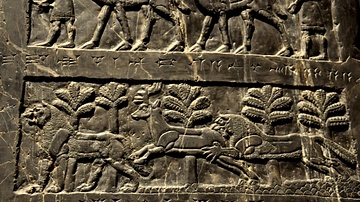
The Black Obelisk of Shalmaneser III, side A, 4th register
Lions and a stag from Marduk-apla-usur the Suhean, probably for the Royal hunting park. Suhi is an area on the middle Euphrates, between modern Syria and Iraq. From Nimrud, (ancient Kalhu), near...
Collection
Fertile Crescent - Cradle of Civilization
The Fertile Crescent is a region stretching from northern Egypt across to the Persian Gulf and was the home to the oldest civilizations in history such as the Sumerians, earning it the common name of the 'Cradle...
