
Search
Did you mean: Empire?
Remove Ads
Advertisement
Search Results

Image
Map of Peter the Great and the Russian Empire, c. 1725 - War, Reform, and Russia’s Rise as a Great Power
The Russian Empire under Peter I (reign 1682–1725) emerged from an intensified process of military and state-building reform rather than a sudden break with...

Image
Map of the The Roman Empire under the Flavian Dynasty, c. 96 - Provinces, Frontiers, and Expansion after 69 CE
The Roman Empire at the close of the Flavian dynasty (69–96 CE) reflected a period of political recovery and administrative consolidation following the...

Article
The Salt Trade of Ancient West Africa
Salt from the Sahara desert was one of the major trade goods of ancient West Africa where very little naturally occurring deposits of the mineral could be found. Transported via camel caravans and by boat along...

Article
The Extent of the Roman Empire
Time has seen the rise and fall of a number of great empires - the Babylonian, the Assyrian, the Egyptian, and lastly, the Persian. Regardless of the size or skill of their army or the capabilities of their leaders...

Article
What Were the Consequences of WWII?
The consequences of the Second World War (1939-45) were many and varied. Nazi Germany, Fascist Italy, and military-dominated Japan were all defeated. Many occupied countries were liberated and regained their freedom...

Article
Enemies of Rome in the 3rd Century CE - The Greatest Enemy of Rome was Rome Itself
It has been said that the greatest enemy of Rome was Rome itself, and this is certainly true of the period known as the Crisis of the Third Century (also known as the Imperial...

Article
Interview with Barry Strauss: Jews vs. Rome - The Latest Book by Barry Strauss
For over two centuries, ancient Judea was a restless province of the Roman Empire, marked by rebellions, shifting loyalties, and the tensions between imperial might and local identity...
Interview
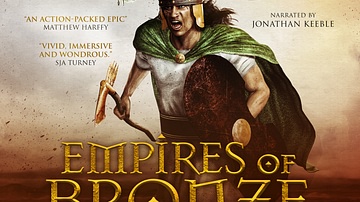
Author Interview: Son of Ishtar by Gordon Doherty
Today we sit down with Gordon Doherty to discuss his new book Empires of Bronze: Son of Ishtar. Based in the dark and cold north (i.e. Scotland), Gordon has written extensively on ancient Greece and...

Book Review
Raiders, Rulers, and Traders: The Horse and the Rise of Empires
The Silk Road may have carried the world’s most luxurious fabrics for trade, but it was paved with horses’ hooves. From the Bronze Age to the 20th century, the empires of China, Persia, India...

Book Review
Edge of Empires: A History of Georgia
Few English-language histories of the country and land of Georgia have been written. Donald Rayfield's Edge of Empires: A History of Georgia attempts to fill this gap. Rayfield is a scholar of Russian and Georgian...
