
Search
Did you mean: Emperor Zeno?
Remove Ads
Advertisement
Search Results

Definition
Hongwu Emperor
The Hongwu Emperor (r. 1368-1398 CE) was the founder of the Ming dynasty (1368-1644 CE) which took over from the Mongol Yuan dynasty (1276-1368 CE) as the rulers of China. Born a peasant with the name Zhu Yuanzhang, the future emperor led...

Definition
Emperor Zeno
Zeno was Byzantine emperor from 474 until 491 CE. An ethnic Isaurian, Zeno was repeatedly criticized as an outsider during his reign, which was full of rebellions and attacks by the Ostrogoths. He is best known for his failed attempt to compromise...

Image
Yin and Yang
The Chinese yin and yang are an important element of Chinese philosophy and religion, representing the principle that all things exist as inseparable and contradictory opposites, the correct balance of which creates harmony. They are mutually...

Article
Most Popular Gods & Goddesses of Ancient China
There were over 200 gods and goddesses worshipped throughout ancient China, but if one were to count every deity or spirit, the number would be over 1,000. Each town, village, city, field, farm, and sometimes even separate plot in a graveyard...

Video
The hidden meanings of yin and yang - John Bellaimey
View full lesson here: http://ed.ted.com/lessons/the-hidden-meanings-of-yin-and-yang-john-bellaimey The ubiquitous yin-yang symbol holds its roots in Taoism/Daoism, a Chinese religion and philosophy. The yin, the dark swirl, is associated...
Definition
Emperor Kammu
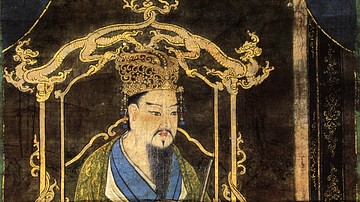
Emperor Kammu (aka Kanmu) reigned in ancient Japan from 781 to 806 CE and is most noted for relocating the capital to Heiankyo (Kyoto) in 794 CE. Kammu was one of the most powerful emperors Japan had seen or would ever see, and his reign...

Definition
Chinese Literature
Chinese literature is among the most imaginative and interesting in the world. The precision of the language results in perfectly realized images whether in poetry or prose and, as with all great literature, the themes are timeless. The Chinese...

Definition
Titus (Roman Emperor)
Titus was Roman emperor from 79 to 81 CE. On June 24, 79 CE Titus Flavius Vespasianus succeeded his father Vespasian (r. 69-79 CE) as emperor of the Roman Empire. Prior to his ascension to the throne, he was considered by many as “…unpopular...

Image
Lady Yang
Chinese beauty Yang Guifei, consort of the Tang emperor Xuanzong (AD 685-762), playing the flute, seated alone on an elaborate Chinese-style throne, surrounded by flowering trees and peonies in open mountain landscape. Japanese painting from...

Definition
Emperor Taizu of Song
Emperor Taizu (960-976 CE), formerly known as Zhao Kuangyin, was the founder of the Song (aka Sung) dynasty which ruled China from 960 to 1279 CE. Taizu settled for a territorially smaller but more unified and prosperous China than was seen...
