
Search
Remove Ads
Advertisement
Search Results

Definition
Mandate of Heaven
The Mandate of Heaven (Tianming), also known as Heaven's Mandate, was the divine source of authority and the right to rule of China's early kings and then emperors. The ancient god or divine force known as Heaven or Sky selected a particular...

Definition
The Barracks Emperors - Instability of Populist Rule
The "barracks emperors" is a term coined by later historians referring to the Roman emperors who were chosen and supported by the army during the period known as the Crisis of the Third Century (also known as the Imperial Crisis, 235-284...

Definition
Wu Zetian
Empress Wu Zetian (Empress Consort Wu, Wu Hou, Wu Mei Niang, Mei-Niang, and Wu Zhao, l. 624-705 CE, r. 690-704 CE) was the only female emperor of Imperial China. She reigned during the Tang Dynasty (618-907 CE) and was one of the most effective...

Definition
Diocletian
Diocletian was Roman emperor from 284 to 305 CE. After the defeat and death of the Roman emperor Philip the Arab in 249 CE, the empire endured over three decades of ineffective rulers. The glory days of Augustus, Vespasian, and Trajan were...

Definition
Caligula - The First Mad Emperor of Rome
Caligula (12-41 CE) was the third Roman emperor, who reigned from 37 to 41 CE. A member of the Julio-Claudian Dynasty, he came to power after the death of his great-uncle Tiberius. The ancient sources claim that he was initially a popular...

Definition
Caracalla
Caracalla was Roman emperor from 211 to 217 CE. Born Lucius Septimius Bassianus, son of Septimius Severus and Julia Domna, he became co-ruler with his father in 198 CE and sole ruler after the death of his father in 211 CE and of his brother...

Definition
Ming Dynasty
The imperial Ming dynasty ruled China from 1368 to 1644. It replaced the Mongol Yuan dynasty which had been in power since the 13th century. Despite challenges from abroad and within, the Ming dynasty oversaw an unprecedented growth in China's...

Definition
Ancient China
Ancient China produced what has become the oldest extant culture in the world. The name 'China' comes from the Sanskrit Cina (derived from the name of the Chinese Qin Dynasty, pronounced 'Chin') which was translated as 'Cin' by the Persians...

Video
Life of Emperor Titus #10 - The Good Emperor, Roman History Documentary Series
Emperor Titus was the first emperor to succeed his biological father on the imperial throne. He is considered to be one of the few good emperors. His short reign is best remembered for the opening of the Flavian Amphitheater(Colosseum) in...
Definition
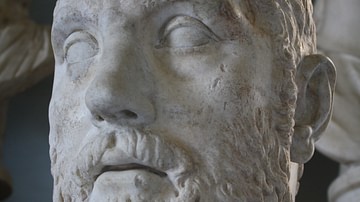
Macrinus
Macrinus was Roman emperor from April 217 to June 218 CE. It is a story that has been told countless times before - an emperor is assassinated leaving no heir or successor. On April 8, 217 CE Roman Emperor Caracalla was murdered, supposedly...
