
Search
Remove Ads
Advertisement
Search Results

Article
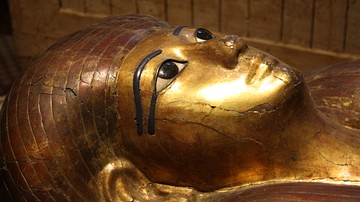
Queen Hatshepsut: Daughter of Amun, Pharaoh of Egypt
Hatshepsut, whose name means "Foremost of Noble Women" or "First Among Noble Women" (royal name, Ma'at-ka-re, translated as "spirit of harmony and truth") was the fifth ruler of the 18th Dynasty (r...
Article
Herodotus on Burial in Egypt
Herodotus' section of his Histories on burial in ancient Egypt (Book II.85-90) is an accurate description of Egyptian mummification, but he purposefully omits the spiritual significance of embalming in keeping with his...

Article
The Soul in Ancient Egypt
At the beginning of time, the god Atum stood on the primordial mound in the midst of the waters of chaos and created the world. The power which enabled this act was heka (magic) personified in the god Heka, the invisible...
Definition
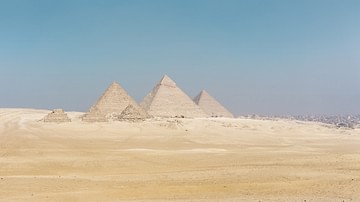
Pyramid
A pyramid is a structure or monument, usually with a quadrilateral base, which rises to a triangular point. In the popular imagination, pyramids are the three lonely structures on the Giza plateau at the edge of the Sahara Desert but...

Article
Festivals in Ancient Egypt
The gods of the ancient Egyptians were always apparent to the people through natural events. The sunrise was Ra emerging from the underworld in his great ship, for example, and the moon was the god Khonsu traveling across...

Article
The Battle of Kadesh & the First Peace Treaty
Ramesses II (The Great, 1279-1213 BCE) ruled Egypt for 67 years and, today, the Egyptian landscape still bears testimony to the prosperity of his reign in the many temples and monuments he had built in...
Article
The Battle of Kadesh & the Poem of Pentaur
The Poem of Pentaur is the official Egyptian record (along with The Bulletin) of the military victory of Ramesses II (known as The Great, 1279-1213 BCE) over the Hittite King Muwatalli II (1295-1272 BCE) at...

Article
Balance & the Law in Ancient Egypt
Egyptian law was based on the central cultural value of ma'at (harmony and balance) which was the foundation for the entire civilization. Ma'at was established at the beginning of time by the gods when the earth...
Article
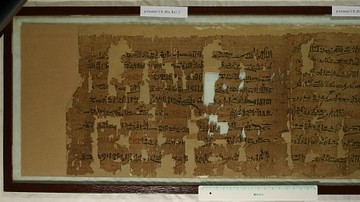
The Satire of the Trades
The literature of ancient Egypt is as rich and varied as any other culture. From the inscriptions of the Old Kingdom of Egypt (c. 2613-2181 BCE) through the Love Poems of the New Kingdom (c. 1570 - c. 1069 BCE) the Egyptian...

Article
Sailing on Lake Nasser towards Abu Simbel
In ancient times, the First Cataract at Aswan marked the southern frontier of Egypt. Beyond lay the land of Nubia, which stretched along the river Nile from the First Cataract southwards for about 250 kilometres...
