
Search
Remove Ads
Advertisement
Search Results

Image
Egyptian Fish Coffin
A wooden coffin shaped in the form of a Nile bolti fish and containing the mummified remains of a fish. Dynasty XXX-XXXI, 4th century BCE. (Egytpian Museum, Turin)
Image
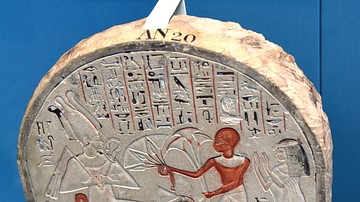
Egyptian Stela of Bakkay
A painted limestone stela where the deceased offers flowers to Osiris. Below, offerings are made to a couple named Huy and Henutnofret by four members of their family. From Egypt. 18th Dynasty, reign of Amenhotep III, circa...

Image
Portion of an Ancient Egyptian Stela
This stela is from the tomb of Espotu, a priest of Amun-Re and son of the second prophet of Amun-Re, Ankhefenkhons. In the inscription, he lists the 22 priesthoods he held, detailing his received a salary for each...

Image
Egyptian King-list
Monumental lists of past kings expressed the living ruler's legitimacy. Originally, Ramesses II was shown on the far right, honoring previous kings and the god Osiris. The kings were represented by their throne names, written...

Definition
Karnak
Karnak is the modern-day name for the ancient site of the Temple of Amun at Thebes, Egypt. The Egyptians called the site Nesut-Towi, "Throne of the Two Lands", Ipet-Iset, "The Finest of Seats" as well as Ipt-Swt, "Selected Spot" also...
Article
Social Structure in Ancient Egypt
The society of ancient Egypt was strictly divided into a hierarchy with the king at the top and then his vizier, the members of his court, priests and scribes, regional governors (eventually called 'nomarchs'), the...

Article
Great Female Rulers of Ancient Egypt
Women in ancient Egypt had more rights than in any other ancient culture and were valued with greater respect. This is evident not only in the physical evidence and inscriptions but in their religion. Some of the...

Definition
Great Pyramid of Giza
The Great Pyramid of Giza is a defining symbol of Egypt and the last of the ancient Seven Wonders of the World. It is located on the Giza plateau near the modern city of Cairo and was built over a twenty-year period during...

Article
The Five Gifts of Hathor: Gratitude in Ancient Egypt
The central cultural value of ancient Egypt was ma'at – harmony and balance – which maintained the order of the universe and the lives of the people. Keeping balance in one's life encouraged the same...

Image
Egyptian Sistrums
Four Egyptian copper alloy/faience sistrums (musical rattles) depicting goddesses (Hathor and Isis). Late Period of ancient Egypt or Ptolemaic Period.
National Archaeological Museum, Athens.
