
Search
Remove Ads
Advertisement

 This answer was generated by
Search Results

Article
The Plague at Athens, 430-427 BCE
In the second year of the Peloponnesian War, 430 BCE, an outbreak of plague erupted in Athens. The illness would persist throughout scattered parts of Greece and the eastern Mediterranean until finally dying out...

Definition
Germ Theory
The germ theory, which emerged in the late 19th century, demonstrated that microscopic germs caused most human infectious diseases. The germs involved included bacteria, viruses, fungi, protozoa, and prions. Louis Pasteur (1822-1895...

Image
Cartonnage Mummy Case & Skeleton of a Child with a Rare Bone Disease
Cartonnage mummy case & skeleton of a child with a rare bone disease called osteogenesis imperfecta (brittle bone disease). His skull and part of his skeleton are on the left side of the...

Video
Demolition, disease, and death: Building the Panama Canal - Alex Gendler
Discover what it took to build the Panama Canal, and how this colossal construction project changed the region. — In the 19th century, the California gold rush brought thousands...

Video
How a Few Scientists Transformed the Way We Think about Disease - Tien Nguyen
View full lesson: http://ed.ted.com/lessons/how-a-few-scientists-transformed-the-way-we-think-about-disease-tien-nguyen This video was created with support from the U.S. Office...
Article
Reactions to Plague in the Ancient & Medieval World
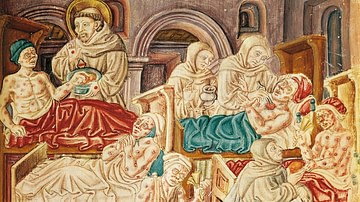
Throughout history, epidemics and pandemics of plague and other diseases have caused widespread panic and social disorder even, in some instances, when the people of one region were aware of a pervasive...

Definition
Egyptian Medicine
Medical practice in ancient Egypt was so advanced that many of their observations, policies, and commonplace procedures would not be surpassed in the west for centuries after the fall of Rome and their practices would inform...

Article
A History of Vaccination - Taming the World's Deadliest Diseases
The field of public health was transformed by the introduction of vaccination, from the Latin word “vacca” meaning cow, to guard people against infectious diseases. It was well known that...

Article
Thucydides on the Plague of Athens: Text & Commentary
The Plague of Athens (429-426 BCE) struck the city, most likely, in 430 BCE before it was recognized as an epidemic and, before it was done, had claimed between 75,000-100,000 lives. Modern-day scholars...

Definition
Antonine Plague
The Antonine Plague, sometimes referred to as the Plague of Galen, erupted in 165 CE, at the height of Roman power throughout the Mediterranean world during the reign of the last of the Five Good Emperors, Marcus Aurelius Antoninus...
