
Search
Did you mean: Diomedes?
Remove Ads
Advertisement
Search Results

Definition
Anaximenes
Anaximenes of Miletus (l. c. 546 BCE) was a younger contemporary of Anaximander and generally regarded as his student. Known as the Third Philosopher of the Milesian School after Thales (l. c. 585 BCE) and Anaximander (l. c. 610 - c. 546...

Definition
Pyrrho
Pyrrho of Elis (l. c. 360 to c. 270 BCE) was a Greek skeptic philosopher credited with founding the school of Pyrrhonism which taught that one must resist making judgments or stating conclusions because sense perception did not correlate...

Definition
Philolaus
Philolaus (l. c. 470 to c. 385 BCE) was a Pythagorean philosopher who claimed that fire was the first cause of existence and heat the underlying source of human life. He is best known for his pyrocentric model of the universe, which replaced...

Definition
Byzantine Emperor
The Byzantine Emperor ruled as an absolute monarch in an institution which lasted from the 4th to 15th century CE. Aided by ministers, high-ranking nobility, and key church figures, the emperor (and sometimes empress) was commander-in-chief...

Definition
Michael Psellos
Michael Psellos (1018 - c. 1082 CE) was a Byzantine historian, writer, and intellectual. Michael acted as courtier and advisor to several Byzantine emperors, and he was the tutor of Michael VII. Writing between 1042 and 1078 CE, his texts...

Article
The Spartacus Revolt
The revolt of the gladiator Spartacus in 73-71 BCE remains the most successful slave revolt in the history of Rome. The rebellion is known as the Third Servile War and was the last of three major slave revolts which Rome suppressed. The story...
Article
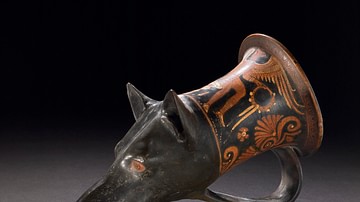
Dogs & Their Collars in Ancient Greece
Dogs in ancient Greece are regularly depicted in art, on ceramics, in literature, and other written works as loyal companions, guardians, hunters, and even as great intuitive thinkers; all of these expressing the deep admiration the Greeks...

Video
The Philosophy of Cynicism - William D. Desmond
Explore the ancient Greek philosophy of cynicism, which calls for the rejection of materialism and conformity in favor of a simple life. — In the 4th century BCE, a young Diogenes of Sinope was found to be counterfeiting coins. He...
Image
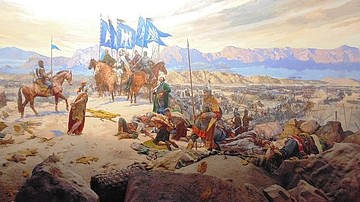
Battle of Manzikert
A painting depicting the aftermath of the Battle of Manzikert (Mantzikert) in August 1071 CE. The battle, in Armenia, was one of the greatest defeats suffered by the Byzantine Empire. The victorious Seljuk army captured the Byzantine emperor...

Image
Romanos IV Histamenon
A gold Byzantine histamenon coin of the emperor Romanos IV Diogenes (r. 1068-1071 CE). (Classical Numismatic Group, Inc. http://www.cngcoins.com)
