
Search
Did you mean: Karma?
Remove Ads
Advertisement
Search Results

Definition
Mandala
A mandala (Sanskrit for “circle”) is an artistic representation of higher thought and deeper meaning given as a geometric symbol used in spiritual, emotional, or psychological work to focus one's attention. The image first appears in...

Definition
Mahayana Buddhism
Mahayana Buddhism is the largest Buddhist sect in the world, and its beliefs and practices are what most non-adherents recognize as "Buddhism" in the modern era. It developed as a school of thought sometime after 383 BCE, possibly...
Definition
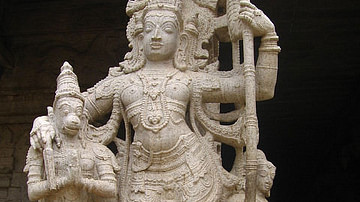
Rama - Seventh Avatar of Vishnu
Rama (or Ramacandra) is the seventh avatar of the Hindu god Vishnu. His adventures include the slaying of the demon king Ravana which is recounted in the Vana Parva of the Mahabharata and in the Ramayana, the oldest...

Definition
Sutra
A sutra (Sanskrit for “thread”) is a written work in the belief systems of Hinduism, Jainism, and Buddhism which is understood to accurately preserve important teachings of the respective faiths and guide an adherent on the path from...

Definition
Vardhamana
Vardhamana (l. c. 599-527 BCE), better known as Mahavira (“Great Hero”) is the sage credited with founding of the nontheistic religion of Jainism, a belief system established in the 6th and 5th centuries BCE in India, which provided...

Definition
Dhammapada
Tipitaka (Sansktrit: Tripitaka), the Buddhist canon, consists of three pitaka (Tri means three and Pitaka refers to boxes), namely Vinaya or Monastic regimen, Sutta (Sanskrit: Sutra) or Discourses and Abhidhamma (Sanskrit: Abhidharma...

Definition
Perfection of Wisdom
Perfection of Wisdom is the foundational text of the Mahayana Buddhist school, a kind of anthology of works, thematically linked, composed between c. 50 BCE - c. 600 CE in India by Mahayana Buddhist scribes. It is comprised...

Definition
Four Noble Truths
The Four Noble Truths are the foundational tenets of Buddhism, which spark awareness of suffering as the nature of existence, its cause, and how to live without it. The truths are understood as the realization which led to the...

Article
Caste System in Ancient India - Varna Ideals in Vedic Times
Ancient India in the Vedic Period (c. 1500-1000 BCE) did not have social stratification based on socio-economic indicators; rather, citizens were classified according to their Varna or castes...

Article
The Ajanta Caves
The 30 caves at Ajanta lie to the north of Aurangabad in the Indhyadri range of Western Ghats. The caves, famous for their temple architecture and many delicately drawn murals, are located in a 76 m high, horseshoe-shaped escarpment...
