
Search
Did you mean: Cimon?
Remove Ads
Advertisement
Search Results
Definition
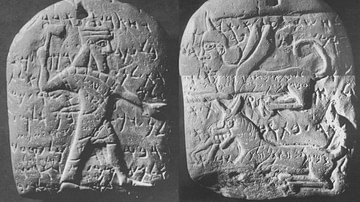
Arslan Tash Amulet
Dated to the 7th century BCE, the Arslan Tash amulet (AT1) was discovered in Arslan Tash, Syria and contains the writing of Phoenician, magic incantations. The limestone plaque includes a variety of features: incantations perceived...

Definition
Gilgamesh
Gilgamesh is the semi-mythic King of Uruk best known as the hero of The Epic of Gilgamesh (c. 2150-1400 BCE) the great Babylonian poem that predates Homer's Iliad and Odyssey by 1500 years and, therefore, stands as the oldest piece...

Definition
Ereshkigal - Mesopotamian Queen of the Dead
Ereshkigal (also known as Irkalla and Allatu) is the Mesopotamian Queen of the Dead, who rules the underworld. Her name translates as "Queen of the Great Below" or "Lady of the Great Place." She was responsible...

Definition
Kali
Kali is the Hindu goddess of death, time, and doomsday. She is often associated with sexuality and violence but is also considered a strong mother figure and symbol of motherly love. Kali embodies shakti – feminine energy, creativity and...

Definition
Gula - The Sumerian Goddess of Doctors and the Healing Arts
Gula (also known as Ninkarrak) is the Sumerian goddess of healing and patroness of doctors, healing arts, and medical practices. She is first attested to in the Ur III period (circa 2112 to circa...

Definition
Kikimora
Kikimora (pronounced Kih-kee-mora) is a female house spirit from Slavic lore who can be helpful or malevolent depending on the behavior of the homeowner. In differing versions of her stories, there are two kinds of spirit, one generally...

Definition
Hanuman
Hanuman is one of several zoomorphic characters in Indian mythology, but is the only wholly animal figure who is revered as a god today. The mythic texts speak of him as a monkey child of the Wind God, as possessing enormous strength...

Article
The Queen of the Night - The Mysterious Burney Relief
The Queen of the Night (also known as the "Burney Relief") is a high-relief terracotta plaque of baked clay, 19.4 inches (49.5 cm) high, 14.5 inches (37 cm) wide, with a thickness of 1.8 inches (4.8...

Article
Gilgamesh and Huwawa
Gilgamesh and Huwawa is a Sumerian poem relating the expedition of Gilgamesh and Enkidu to the Cedar Forest and the slaying of the monster-demon Huwawa. The work predates and informs The Epic of Gilgamesh in which the death...

Article
Ghosts in the Middle Ages
The medieval Church informed the people's religious imagination during the Middle Ages (c. 476-1500) and the world was therefore interpreted - even by heterodox Christians - through the Church's lens. Ghosts – referred...
