
Search
Remove Ads
Advertisement
Search Results

Article
Custer's Account of the Battle of Washita River
My Life on the Plains or Personal Experiences with Indians (1874) is a full-length narrative by George Armstrong Custer (l. 1839-1876) of his time out west from 1867-1874. The work includes his observations...

Definition
Athanaric
Athanaric (died c. 381 CE) was a king of the Thervingi Goths (better known as the Visigoths) and, according to some sources, the first and greatest king. He was of the noble Balts family of the Thervingi tribe and a relative of the...

Article
Battle of Wagram
The Battle of Wagram (5-6 July 1809) was one of the largest and bloodiest battles of the Napoleonic Wars (1803-1815). It resulted in a pyrrhic victory for French Emperor Napoleon I (r. 1804-1814; 1815) whose army crossed the Danube...
Article
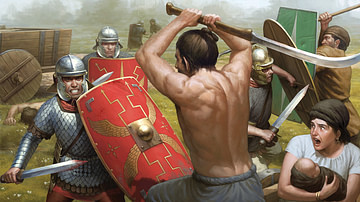
Legions of the Dacian Wars
The Dacian Wars started after Decebalus (r. c. 87-106 CE) raided the Roman province of Moesia in 85 CE. Emperor Domitian's (r. 81-96 CE) Dacian campaigns in 86-87 CE reached an uneasy peace, but the conflict was renewed...

Definition
Johann Strauss II
Johann Strauss II (1825-1899), aka Strauss the Younger, was an Austrian composer best known for his waltzes such as The Blue Danube. Famed throughout Europe and the United States in his own lifetime, Strauss was known as the...

Definition
Hyperborea
In Greek mythology, Hyperborea was the land located to the far north of the known world and it was so remote it was considered even beyond the North Wind. There a legendary race known as the Hyperboreans lived and worshipped the sun...

Image
Map of Niger River
The Niger River is the most important river in West Africa, and is the third longest river in Africa after the Nile River and Congo River. Known for its distinctive "boomerang" shape, the Niger River flows from the Guinea Highlands...
Article
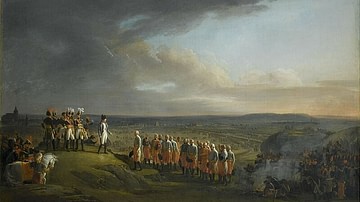
Ulm Campaign
The Ulm Campaign (25 September to 20 October 1805) was a military operation during the War of the Third Coalition (1805-1806). Through a series of maneuvers, the 210,000 men of the French Grande Armée, led by Emperor Napoleon I...

Definition
Attila the Hun
Attila the Hun (r. 434-453 CE) was the leader of the ancient nomadic people known as the Huns and ruler of the Hunnic Empire, which he established. His name means "Little Father" and, according to some historians, may not have...
Image
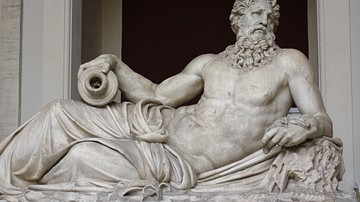
Roman River God Arno
A Roman marble statue depicting the River god Arno (the river which runs through Florence). First half of the 2nd century CE, although the head is a Renaissance replacement. (Vatican Museums, Rome)
