
Search
Remove Ads
Advertisement
Search Results

Definition
Faravahar
The faravahar is the best-known symbol from ancient Persia of the winged sun disk with a seated male figure in the center. It is thought to represent Ahura Mazda, the god of Zoroastrianism, but has also been interpreted to signify...

Definition
Mithra
Mithra is the Persian god of the rising sun, contracts, covenants, and friendship. He also oversaw the orderly change of the seasons, maintained cosmic order, and was responsible for bestowing divine grace on kings, legitimizing their...

Video
2600 years of history in one object (Neil MacGregor)
http://www.ted.com A clay cylinder covered in Akkadian cuneiform script, damaged and broken, the Cyrus Cylinder is a powerful symbol of religious tolerance and multi-culturalism. In this enthralling...
Image
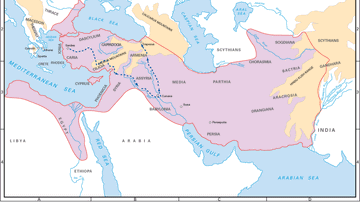
Map of Persia and the March of the Ten Thousand
A map of Persia, indicating major settlements, regions, and mountain ranges, as well as the march of the Ten Thousand (dotted line). The Ten Thousand were a group of mercenary units, mainly Greek, drawn...

Image
Matt Waters
Matt Waters, the author of King of the World: The Life of Cyrus the Great.

Article
The Life of Antisthenes of Athens in Diogenes Laertius
Antisthenes (c. 445-365 BCE) was a Greek philosopher who founded the Cynic School of Athens. He was a follower of Socrates and appears in Plato's Phaedo as one of those present at Socrates' death...

Definition
Mesopotamia - The Beginning of Beginnings
Mesopotamia (from the Greek, meaning "between two rivers") was an ancient region located in the Near East (Middle East) bounded in the northeast by the Zagros Mountains and in the southeast by the Arabian Plateau...

Video
The Achaemenid Empire: Persia
This video delves deeper into the reign of Cyrus the Great as he overthrows the Medians to establish the Achaemenid Empire, the first official Persian Empire.

Image
Map of the Achaemenid Persian Empire c. 500 BCE
The Achaemenid Persian Empire emerged in the mid-6th century BCE when Cyrus II (reign 559–530 BCE) united the Persian tribes and overthrew the Median kingdom (c. 550 BCE), establishing a new imperial state...

Definition
Religion in the Ancient World - Order and the Spiritual Experience
Religion (from the Latin Religio, meaning "restraint," or Relegere, according to Cicero, meaning "to repeat, to read again," or, most likely, Religionem, "to show respect for what is sacred"...
