
Search
Did you mean: Punt?
Remove Ads
Advertisement
Search Results

Definition
Martyr
A martyr is someone who voluntarily dies for either a religious or secular cause. The word originates from "witness" in Greek and is related to a witness in court testifying to one's beliefs or truth, despite the risk involved. As such, it...

Definition
Sif
Sif is a fertility goddess in Norse mythology, wife of the thunder god Thor, best known for the story in which the trickster god Loki cuts her hair as a prank and is forced to replace it with a magical headpiece, leading to the creation of...

Definition
Ammon (Deity)
Ammon is the name of a Libyan deity and his oracle in the desert. It became famous after Alexander the Great made a detour to consult the god. The modern name is Siwa. Oracle at Siwa Ammon was a Libyan deity, whose oracle was situated...
Definition
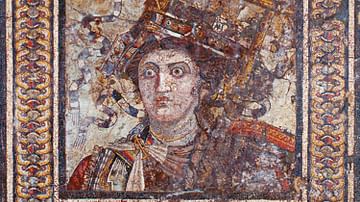
Berenice II Euergetis
Berenice II Euergetis (c. 267-221 BCE) was a pre-eminent Hellenistic queen, who ruled together with her husband Ptolemy III (r. 246-221 BCE), when the Ptolemaic kingdom was at the height of its power, dominating most of the eastern Mediterranean...

Definition
Freyr
Freyr (Old Norse for 'Lord', sometimes anglicised as Frey) is the main fertility god in Norse mythology, his connection with harvests, sun and rain, virility, weddings, and his rule over wealth securing him an important position within the...
Definition
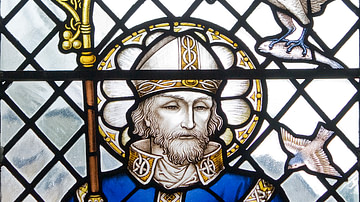
Saint Cuthbert
Saint Cuthbert (c. 634 - 20 March 687) was an Anglo-Saxon monk from the Kingdom of Northumbria, who became the bishop of Lindisfarne and one of the most important saints of the medieval church in England. He first became a monk at Melrose...

Article
Daily Life in Ancient Egypt
The popular view of life in ancient Egypt is often that it was a death-obsessed culture in which powerful pharaohs forced the people to labor at constructing pyramids and temples and, at an unspecified time, enslaved the Hebrews for this...

Article
Religion in the Middle Ages
Religion in the Middle Ages, though dominated by the Catholic Church, was far more varied than only orthodox Christianity. In the Early Middle Ages (c. 476-1000), long-established pagan beliefs and practices entwined with those of the new...

Article
Ancient Mesopotamian Beliefs in the Afterlife
Unlike the rich corpus of ancient Egyptian funerary texts, no such “guidebooks” from Mesopotamia detail the afterlife and the soul's fate after death. Instead, ancient Mesopotamian views of the afterlife must be pieced together from a variety...

Article
Early Christianity
Emerging from a small sect of Judaism in the 1st century CE, early Christianity absorbed many of the shared religious, cultural, and intellectual traditions of the Greco-Roman world. In traditional histories of Western culture, the emergence...
