
Search
Did you mean: Ceres?
Remove Ads
Advertisement
Search Results

Article
Weapons of the Conquistadors
The Iberian conquistadors ("conquerors") were the first military men to explore, attack, and conquer territories in the Americas and Asia that would then become a part of the Spanish or Portuguese Empire. Indigenous...

Article
Turquoise in Mesoamerica
Turquoise was a highly-prized material in ancient Mesoamerica, perhaps the most valued of all materials for sacred and decorative art objects such as masks, jewellery, and the costumes of rulers and high priests. Turquoise...

Article
The Siege of Cusco in 1536-7
The two sieges of Cusco in 1536-7 were the last great military actions by the Incas as they tried to reclaim their empire from the Spanish conquistadors led by Francisco Pizarro (c. 1478-1541). The European cavalry proved...

Article
Pizarro and Atahualpa: The Curse of the Lost Inca Gold
In November 1532 CE, Francisco Pizarro led a group of about 160 conquistadors into the Inca city of Cajamarca. The illiterate and illegitimate son of an Extremaduran nobleman and an impoverished...

Article
Treasure Ports of the Spanish Main
The treasure ports of the Spanish Main such as Cartagena, Portobelo, Panama, and Veracruz were used to collect the riches the Spanish Empire had extracted from the Americas, ready for transport in the two annual...

Article
Medieval Climate Anomaly in the Americas
To climatologists, the period of seven to twelve centuries ago was known as a "Climate Anomaly" or a "Warm Period" (800-1300 CE). To archaeologists, it was a time of great change, a period when cultural patterns...

Image
Map of the Rise and Fall of the Mexica (Aztec) Empire - Alliance, Expansion, and Tribute Power in Mesoamerica
The Mexica (commonly referred to as the Aztecs) emerged as a dominant power in central Mexico during the Late Postclassic period, culminating in the formation...

Image
Sacred Precinct, Tenochtitlan
A model reconstruction of the sacred precinct of Tenochtitlan, the Aztec capital on Lake Texcoco. The city was founded in 1345 CE and fell to the Spanish forces led by Cortés in 1521 CE. The sacred complex was dominated...

Image
Headdress of Motecuhzoma II
The headdress of Motecuhzoma II, Aztec ruler 1502-1520 CE. Although there is no evidence that it was ever worn by Motecuhzoma the headdress may have been amongst the gifts he gave to Cortés, who in turn passed them on...
Image
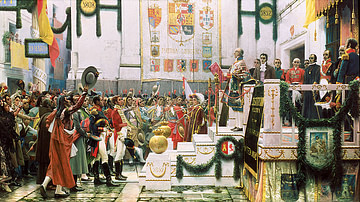
Proclamation of the Spanish Constitution of 1812
Proclamation of the Spanish Constitution of 1812 by the Cortés de Cádiz during the Peninsular War, image by Salvador Viniegra, 1912.
