
Search
Remove Ads
Advertisement
Search Results

Article
Gibbon's Decline & Fall of the Roman Empire
The English historian Edward Gibbon (1737-1794) wrote and published his seminal work History of the Decline and Fall of the Roman Empire between 1776 and 1788. The dominant theme of Gibbon's six-volume work...

Article
The Splendours of Roman Algeria
Algeria, Africa's largest country, stretches from the Mediterranean coastline to the Saharan desert interior. The country has some of the finest and most diverse Roman sites, including Timgad and Djémila, both well-preserved...
Article
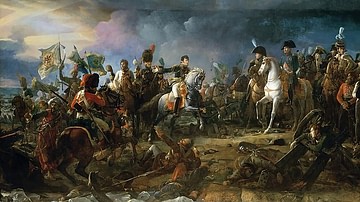
Battle of Austerlitz
The Battle of Austerlitz (2 December 1805), or the Battle of the Three Emperors, was one of the most significant battles of the Napoleonic Wars (1803-1815). It saw French Emperor Napoleon I (r. 1804-1814; 1815) and his Grande...

Article
The Last Kingdom TV Series - Historical Accuracy
The Last Kingdom (2015-2022) is a historical fiction TV series based on Bernard Cornwell's The Saxon Stories novels and adapted for television by English screenwriter Stephen Butchard. With five seasons...

Article
The Ideal of Christendom in the Middle Ages & Beyond
The ideal of Christendom in antiquity joined separate nations into one single community carrying out the precepts of the God of Israel. Constantine's conversion to Christianity resulted in the merging...

Article
Pliny the Younger on Christianity
Pliny the Younger's (61-112 CE) letter (Epistulae X.96) to Roman Emperor Trajan (r. 98-117 CE) is one of our earliest sources on Christianity from an outsider's point of view. It highlights the Christian movement's...

Article
The Monastic Movement: Origins & Purposes
In 313 CE, Constantine the Great (272 – 337 CE) ended the sporadic-yet-terrifying Christian persecutions under the Roman Empire with his “Edict of Milan,” and brought the Christian church under imperial protection...

Video
The New Roman Empire - Interview with Anthony Kaldellis
A major new history of the eastern Roman Empire, from Constantine to 1453. In recent decades, the study of the Eastern Roman Empire, also known as Byzantium, has been revolutionized by new approaches...

Image
Map of the Latin Empire - A Crusader State in Constantinople - The Fourth Crusade and the Fragmentation of Byzantium
The Latin Empire (Imperium Romaniae, 1204–1261) emerged after the Fourth Crusade (1202–1204) captured and sacked Constantinople in April 1204, replacing...

Article
Monotheism in the Ancient World
Monotheism is simply defined as the belief in one god and is usually positioned as the polar opposite of polytheism, the belief in many gods. However, the word monotheism is a relatively modern one that was coined...
