
Search
Did you mean: Constantine VI?
Remove Ads
Advertisement
Search Results

Definition
Byzantine Coinage
The coinage of the Byzantine Empire continued that of its more ancient predecessors and functioned as a convenient method of payment for goods and services, especially to soldiers and officials, and as a means for people to pay...

Definition
Despotate of the Morea
The Despotate of the Morea was a semi-autonomous appanage of the later Byzantine Empire. The Byzantines retook part of the Peloponnese in Southern Greece in 1262 CE, but the Morea was only officially governed by semi-autonomous...

Definition
Nikephoros II Phokas
Nikephoros II Phokas was Byzantine emperor from 963 to 969 CE. Known as “White Death of the Saracens,” Nikephoros was a fearsome commander who conquered Crete, Cilicia, and much of Syria. While he is known as a great military...

Image
Constantine's Conversion
The Emblem of Christ Appearing to Constantine / Constantine's conversion, oil on panel painting by Peter Paul Rubens, 1622.
Philadelphia Museum of Art.

Image
Inscription, Arch of Constantine I
The inscription which appears on both sides of the Arch of Constantine I in Rome. Dedicated in 315 CE, the triumphal arch celebrates the emperor's victory over the Roman tyrant Maxentius in 312 CE. The inscription...
Image
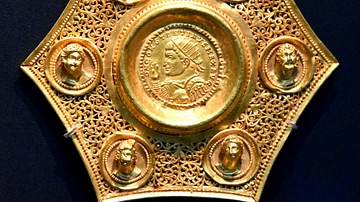
Gold Coin Pendant of Constantine
Gold pendant set with a coin of Constantine the Great, c 320s CE. The British Museum, London. The pendant is made in a pierced metalwork technique popular in fine jewellery of the time. The obverse of the coin depicts...
Image
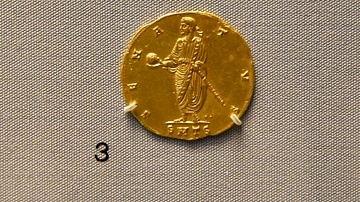
Gold Medallion of Constantine the Great
Medallions with designs similar to coins could be worn as a symbol of allegiance, or given as prestigious gifts. They were specifically to be attractive, as display or presentation pieces. Gold medallion of...
Image
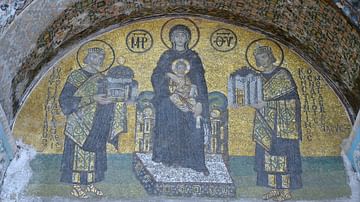
Mosaic with the Virgin Mary, Constantine and Justinian, Hagia Sophia
Mosaic panel located at the southwestern entrance of the basilica Hagia Sophia (Istanbul) depicting the emperor Constantine I holding a model of the city of Constantinople (right), the...

Image
Constantine I
The colossal bronze head from a statue of Constantine I, 4th century CE. The head is 1.77 m high. (Capitoline Museums, Rome).

Image
Arch of Constantine I
The north side of the Arch of Constantine I in Rome. Dedicated in 315 CE, the triumphal arch celebrates the emperor's victory over the Roman tyrant Maxentius in 312 CE. It is the largest surviving triumphal arch and the last...
