
Search
Remove Ads
Advertisement
Search Results

Image
The Twelve Major Sieges of Constantinople (626–1453 CE) - War, Survival, and the Fall of the Byzantine Capital
The city of Constantinople, founded as an imperial capital by Constantine I in 330 CE, occupied a commanding position on the Bosporus between Europe and...

Article
Boccaccio on the Black Death: Text & Commentary
The Black Death is the name given to the plague outbreak in Europe between 1347-1352 CE. The term was only coined after 1800 CE in reference to the black buboes (growths) which erupted in the groin, armpit...

Definition
Swahili Coast
The Swahili Coast on the shores of East Africa was a region where Africans and Arabs mixed to create a unique identity from the 8th century called Swahili Culture. Swahili is the name of their language and means 'people of the coast.'...

Definition
Maya Civilization
The Maya are an indigenous people of Mexico and Central America who have continuously inhabited the lands comprising modern-day Yucatan, Quintana Roo, Campeche, Tabasco, and Chiapas in Mexico and southward through Guatemala...

Definition
Despotate of the Morea
The Despotate of the Morea was a semi-autonomous appanage of the later Byzantine Empire. The Byzantines retook part of the Peloponnese in Southern Greece in 1262 CE, but the Morea was only officially governed by semi-autonomous...

Definition
Tikal
Tikal, located in the north of the Petén region of Guatemala, was a major Maya city which flourished between 300 and 850 CE. The city, known to the Maya themselves as Mutul, is one of the grandest in Mesoamerica. Amongst the first Maya...

Definition
Ghosts in the Ancient World - The Return of the So-Called Dead
A belief in an afterlife was central to every major civilization of the ancient world and this encouraged the recognition of the reality of ghosts as the spirits of the departed who, for one...

Definition
Hammurabi - Conquerer, King, and Law-Giver
Hammurabi (reign 1792-1750 BCE) was the sixth king of the Amorite First Dynasty of Babylon, best known for his famous law code, which served as the model for others, including the Mosaic Law of the Bible. He...

Definition
Fraumunster
Fraumünster Church (“Women's church” in German) is a former Benedictine abbey situated in the heart of Zürich, Switzerland that was founded in the mid-9th century CE by Louis the German and his daughters, Hildegard and Bertha. Flourishing...
Definition
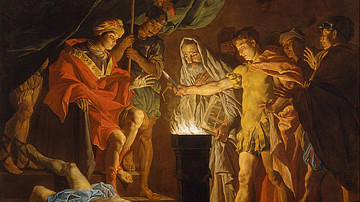
Lars Porsenna
Lars Porsenna was the semi-legendary Etruscan king of Chiusi who famously attacked and probably occupied Rome c. 508 BCE when the city had just exiled its last king and was moving towards becoming a republic. His extravagant tomb...
