
Search
Remove Ads
Advertisement
Search Results

Image
Interior of St. Astvatsatsin Church at Khor Virap Monastery
This is the interior of the St. Astvatsatsin Church, which was built in the 1660s CE. Khor Virap is an ancient Armenian monastery located near the border with Turkey some 8 km (5 mi) from the...
Image
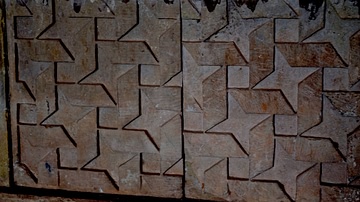
Persian Inspired Decor at Surb Karapet Church
Situated along the Silk Route between Byzantium and Persia, medieval Armenia was influenced by its neighboring cultures. In this picture, one can clearly detect strong the Persian artistic influence on...
Image
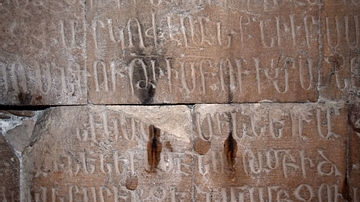
Armenian Inscriptions in Surb Karapet Church
These Armenian Inscriptions in Noravank Monastery's Surb Karapet Church date from the Middle Ages.

Image
Santa Fosca Church, Torcello
The Santa Fosca Church at Torcello, Italy, was constructed during the 11th and 12th centuries and its ground construction is modeled after a Greek cross.

Image
The Church of the Immaculate Conception - Bell Tower
The Church of Immaculate Conception in Dusit, Bangkok, Thailand. It is the 1847 reconstruction, supervised by the influential French missionary, Monsignor Pallegoix (1805-1862). The Neo-Romanesque...

Image
Abbey Church, Fontevraud Abbey
The Abbey Church at Fontevraud Abbey, Pays de la Loire, France. The abbey was founded in 1101.

Image
Interior of St. Astvatsatsin Church at Armenia's Khor Virap Monastery
This is the interior of the St. Astvatsatsin Church, which was built in the 1660s CE. Khor Virap is an ancient Armenian monastery located near the border with Turkey some 8 km (5 mi...

Image
Khachkar within Noravank Monastery's Surb Karapet Church
This exquisite khachkar lies within Noravank Monastery's Surb Karapet Church in Armenia.

Image
Armenian Gravestones at Zorats Church
Surrounding the Zorats Church in what's present-day Armenia are a number of exquisitely carved khachkars dating to the 10th-13th centuries CE and tombstones dating from the 15-17th centuries CE.
Image
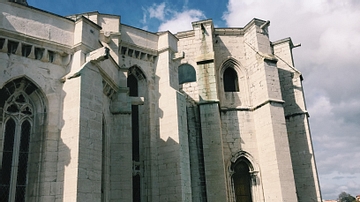
The Church of Santa Maria do Carmo
Church of Santa Maria do Carmo, famous for its beautiful Gothic architecture, established in 1389 CE by D. Nuno Álvares Pereira (1360-1431 CE). Now housing The Carmo Archaeological Museum.
