
Search
Remove Ads
Advertisement
Search Results

Interview
Interview: Korea-Japan Relations Through the Prism of Archaeology
Ancient East Asia was dominated by the three states known today as China, Japan, and Korea. The complex chain of successive kingdoms created a rich web of events that archaeologists have...

Article
Ten Should-Be Famous Women of Early Christianity
There were many famous women of early Christianity who made significant contributions to the development of the faith but have since been largely forgotten. Some have been canonized by the Church or recognized...

Article
Early Christianity
Emerging from a small sect of Judaism in the 1st century CE, early Christianity absorbed many of the shared religious, cultural, and intellectual traditions of the Greco-Roman world. In traditional histories of Western culture...

Article
The Separation of Christianity from Judaism
In the mid-2nd century CE, Christianity began a gradual process of identity-formation that would lead to the creation of a separate, independent religion from Judaism. Initially, Christians were one of many...

Definition
Edo Period
The Edo period refers to the years from 1603 until 1868 when the Tokugawa family ruled Japan. The era is named after the city of Edo, modern-day Tokyo, where the Tokugawa shogunate had its government. It is also sometimes referred...

Article
On the Path of Early Christianity in Marseille
Today, Marseille is known more for its modern history – World War II, North African immigration, and, of course, the rousing choruses of France's national anthem, La Marseillaise. Yet it is also one of...

Article
The Horse-rider Theory in Ancient Japan
The 'horse-rider theory' is a controversial proposal that Japan was conquered around the 4th or 5th century CE by a culture from northern Asia to whom the horse was especially important. Although archaeological...
Article
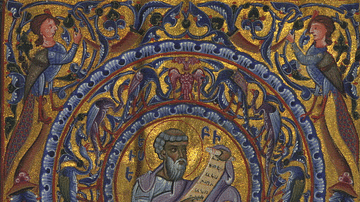
Eusebius on Christianity
Eusebius Pamphili (aka Eusebius of Caesarea, 260-340 CE) was a Christian historian, exegete, and polemicist. He became the bishop of Caesarea Maritima in 314 CE and served as court bishop during the reign of Constantine...

Article
Rome's Response to the Spread of Christianity
During the 1st century CE, a sect of Jews in Jerusalem claimed that their teacher, Jesus of Nazareth, was the 'messiah' of Israel. 'Messiah' meant 'anointed one', or someone chosen by the God of Israel...

Article
Constantine’s Conversion to Christianity
Constantine I (Flavius Valerius Constantinus) was Roman emperor from 306-337 CE and is known to history as Constantine the Great for his conversion to Christianity in 312 CE and his subsequent Christianization...
