
Search
Remove Ads
Advertisement
Search Results
Definition
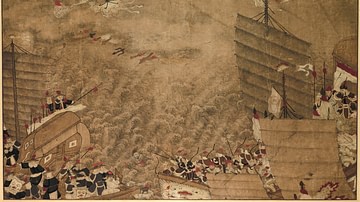
Wako - The Medieval Pirates of Southeast Asia
Wako (aka wokou and waegu) is a term used to refer to Japanese (but also including Chinese, Korean, and Portuguese) pirates who plagued the seas of East Asia from Korea to Indonesia, especially between the...

Image
Spread of Christianity Map (up to 600 CE)
Map showing the spread of Christianity, showing both strongly Christianized areas before 325 CE and generally Christianized areas until 600 CE. The map also shows major Christian centers and the cities in which...
Image
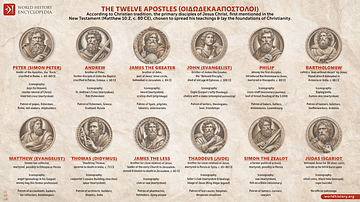
The Twelve Apostles of Christianity
According to Christian tradition, the Twelve Apostles (ΟΙΔΩΔΕΚΑΑΠΟΣΤΟΛΟΙ in Greek, meaning "messengers" or "ones who are sent") were the closest followers of Jesus Christ, chosen to spread his teachings and establish...

Article
The Japanese Invasion of Korea, 1592-8 CE
The two Japanese invasions of Korea between 1592 and 1598 CE, otherwise known as the 'Imjin Wars', saw Toyotomi Hideyoshi (1537-1598 CE), the Japanese military leader, put into reality his long-held plan to...

Image
Spread of Christianity 325-600 AD
This map shows the spread of Christianity around the Mediterranean and Europe. Dark Blue: Spread until 325 AD. Light Blue: Spread until 600 AD. Patrick O'Brien, ed (2003). Atlas of World History. New York...

Definition
Shogun
The shoguns of medieval Japan were military dictators who ruled the country via a feudal system where a vassal's military service and loyalty was given in return for a lord's patronage. Established as an institution by the first shogun...

Article
The Early Christianization of Armenia
The Christianization of Armenia began with the work of Syrian apostles from the 1st century CE and was boosted in the early 4th century CE by such figures as Saint Gregory the Illuminator, who converted the Armenian...

Definition
Minamoto Clan
The Minamoto clan was an extended family group which dominated Japanese government and the imperial court in the 12th and 13th centuries CE. The clan famously defeated their arch rivals the Taira in the Genpei War of 1180-1185 CE...

Definition
League of Nations
The League of Nations was founded in January 1920 to promote world peace and welfare. Created by the Treaty of Versailles, which formally ended the First World War (1914-18), the League provided a forum where nations promised...

Definition
Toyotomi Hideyoshi - Unifier of Japan
Toyotomi Hideyoshi (1537-1598) was a Japanese military leader who, along with his predecessor Oda Nobunaga (1534-1582) and his successor Tokugawa Ieyasu (1543-1616), is credited with unifying Japan in the 16th...
