
Search
Did you mean: Coinage?
Remove Ads
Advertisement
Search Results

Image
Chinese Qin Chariot
A Qin chariot from the 'terracotta army'. Tomb of Shi Huangdi, 259-210 BCE, Shaanxi Province, China.
Image
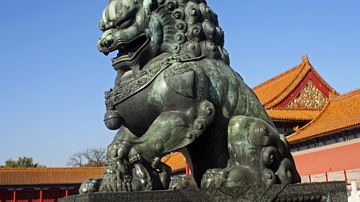
Chinese Lion-Dog
Bronze Lion-Dog (aka Foo-Dog) at the Forbidden City, Beijing, China. They are always placed in pairs; the male has a paw on an ornate ball, representing power and domination over the human affairs of the world while the female...

Image
Chinese Hairpins
Gold hairpins dating from the Tang Dynasty to the 7th century CE.
Image
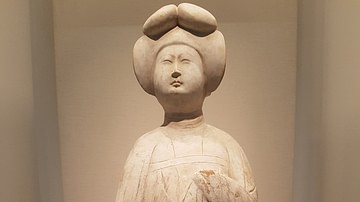
Chinese Female Figurine
712-779 CE. (Head is a reconstruction). Earthenware with pigments. Excavated from Hansenzhai, (eastern suburb of Xi'an), 1988.
From the Xi'an Museum. (Photo taken at the Art Gallery of NSW, Sydney Australia)

Image
Chinese Door Gods
In China gods (menshen) were often painted on either side of a doorway to guard against evil demons or ghosts.
Image
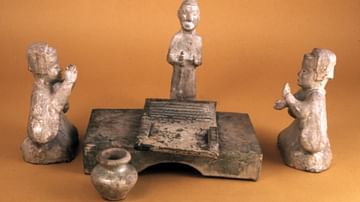
Chinese Board Game
Group of earthenware figures thought to be playing a game of "Liu Bo". Found in a Han Dynasty (1st-2nd century CE) burial.

Image
Chinese Cavalry Rider
An earthenware cavalry rider from the Tang dynasty, China. 618-906 CE. Height: 24 cm.
(The British Museum, London)

Image
Chinese Nephrite Jade Dog Amulet
Dog amulet measuring 63.1 x 19.9 x 20.8 mm (2.4 x 0.78 x 0.81 inches), possibly from the period of the Liangzhu Culture in China (3400-2250 BCE). Jade dog amulets were often made and worn for protection and those...

Image
Chinese Jar with Green Glaze
This jar comes from China and dates from the Sui dynasty (581-618 CE). It is made of stoneware with green glaze. (Iris & B. Gerald Cantor Center for Visual Arts at Stanford University, Stanford, California)

Image
Chinese Ceramic Dog
Green-glazed ceramic dog, Eastern Han Dynasty, 25-220 CE.
Palace Museum, Beijing, China.
