
Search
Did you mean: Coinage?
Remove Ads
Advertisement
Search Results

Definition
Ancient Chinese Calligraphy
Calligraphy established itself as the most important ancient Chinese art form alongside painting, first coming to the fore during the Han dynasty (206 BCE - 220 CE). All educated men and some court women were expected...

Definition
Qilin (Chinese Unicorn)
The qilin (麒麟, or simply lin 麟) is a Chinese mythical creature, frequently translated as "Chinese unicorn." While this term may suggest a one-horned creature, the qilin is often depicted with two horns. However, like the...
Image
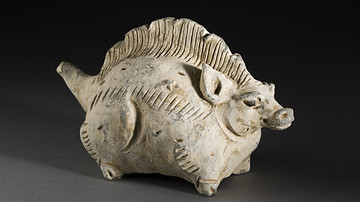
Chinese Pig-Dragon Sculpture
A Chinese pig-dragon sculpture. China, probably Yunnan Province, Yuan dynasty, 1279-1368.
Los Angeles County Museum of Art.

Image
Chinese Dragon Roof Tile
A glazed ceramic roof tile depicting a dragon. Nanjing, Ming dynasty, 1366-1400.
The British Museum, London.

Image
Chinese Terracotta Warrior
A portion of the Terracotta Army, the clay life-size army in the tomb of the Qin emperor Shi Huangdi. c. 210 BCE, Shaanxi Province, China.

Image
Chinese Eunuchs
A mural depicting a group of eunuchs, the slaves and influential advisors of many Chinese emperors. Mural from the tomb of the prince Zhanghuai, 706 CE, Qianling, Shaanxi, China.

Image
Chinese Diamond Sutra
The Buddhist text known as the Diamond Sutra is believed to be the oldest surviving printed book in the world, dated to 868 CE and written in Chinese. This work is one of the most important works of the Buddhist tradition.
Image
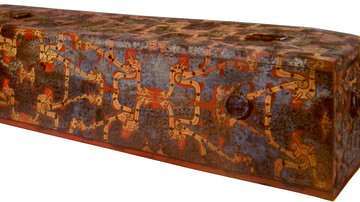
Chinese Lacquered Coffin
A Chinese lacquered coffin with dragon and bird decoration from the Chu state. 4th century BCE. (Hubei Provincial Museum, Wuhan, China)

Image
Chinese Bronze Hoe Coin
Bronze spade money (worth 25 standard coins) with Chinese inscription, minted in China under the rule of Wang Mang, Xin Dynasty, 9-23 CE. Wang Mang's four coinage reforms were not successful and the widely accepted wuzhu...

Image
Chinese Cong
A Chinese cong of jade, a ritual object commonly found in tombs but of unknown function. Unknown date but probably Neolithic. Height: 12.9 cm. (British Museum, London)
