
Search
Remove Ads
Advertisement
Search Results

Video
Making History - Mass production of olives for trade
Stone age people begin to produce a surplus of food so they can trade it to neighboring villages for food or products not available in their area

Video
The US Constitution, 3/5, and the Slave Trade Clause: Crash Course Black American History #9
The drafting and adoption of the United States Constitution recalled many of the high ideals of liberty and freedom that were espoused during the Revolutionary War...

Video
The Silk Road: Trade Route of the Ancient World
The Silk Road was a network of trading routes that connected a number of different regions in the ancient world, stretching over four thousand miles from China, through India and Asia Minor and through...
Image
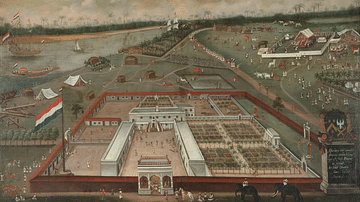
VOC Trade Lodge in Hooghly, Bengal
A 1665 painting by Hendrik van Schuylenbergh showing the Dutch East India Company (VOC) Trade Lodge in Hooghly, Bengal. (Rijksmuseum, Amsterdam)

Image
Possible Pepper Trade Route
A possible trade route for pepper from India to Rome.

Video
The Atlantic Slave Trade: Crash Course
In which John Green teaches you about one of the least funny subjects in history: slavery. John investigates when and where slavery originated, how it changed over the centuries, and how Europeans and colonists...

Video
Bacon's Rebellion and the African Slave Trade [AP U.S. History Review]
On the salty Nathaniel Bacon and how his little rebellion in the early American colonies paved the way for the African Slave Trade.

Article
Wine Culture in the Hellenistic Mediterranean
The culture of drinking wine was enjoyed throughout the Mediterranean world, and what is true now was true in antiquity, too: wine is always good business. The Hellenistic Period (c. 335-30 BCE), between...

Definition
Artaxiad Dynasty
The Artaxiad (Artashesian) dynasty ruled ancient Armenia from c. 200 BCE to the first decade of the 1st century CE. Founded by Artaxias I, the dynasty would ensure Armenia enjoyed a sustained period of prosperity and regional...

Article
The Sea Dogs - Queen Elizabeth's Privateers
The sea dogs, as they were disparagingly called by the Spanish authorities, were privateers who, with the consent and sometimes financial support of Elizabeth I of England (r. 1558-1603 CE), attacked and...
