
Search
Search Results

Image
Carthaginian Mercenaries
An artist's impression of how a troop of Carthaginian mercenaries may have appeared in battle formation.

Image
Carthaginian Ship's Ram
A bronze ram from the prow of a Carthaginian warship. Found off the Aegadian Islands (near Sicily) and dating to the First Punic War (264 and 241 BCE). A Punic inscription dedicates the ram to the Phoenician and Punic god Baal.

Image
Carthaginian Silver Tetradrachm
A silver tetradrachm minted in Carthage, 330-300 BCE. Obv.: head of the goddess Tanit with dolphins. Rev. : horse's head and palm tree. The legend reads 'm mhnt' meaning 'people of the camp', that is army camp. Many such coins were minted...

Image
Carthaginian Government
An artist's impression of what a scene from Carthaginian or Near Eastern government may have looked like.
Image
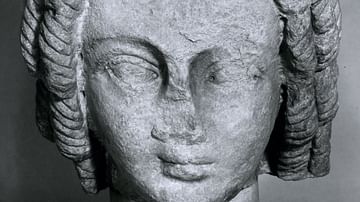
Carthaginian Portrait Bust
A marble portrait bust of a Carthaginian woman. Carthage, 5th-2nd century BCE (?). (British Museum, London)
Image
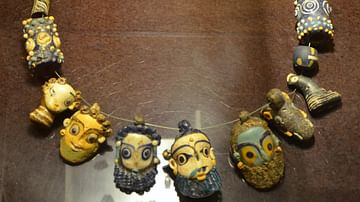
Carthaginian Necklace
A necklace of glass paste beads, Carthage, 4th-3rd century BCE. (National Archaeological Museum, Cagliari)
Image
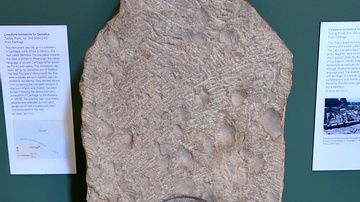
Carthaginian Tombstone for Gemellus
This limestone monument was set up in a cemetery in Carthage, in memory of a man called Gemellus. The inscription towards the base is written in Phoenician, the native language of ancient Carthage, often known as Punic, and states "This tombstone...
Image
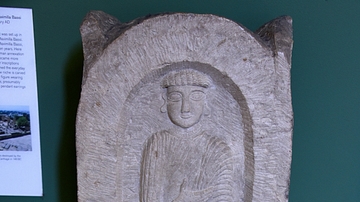
Carthaginian Tombstone for Maximilla Bassi
This finely carved limestone monument was set up in a memory for a woman called Maximilla Bassi. The Latin inscription says "Maximilla Bassi, Pious daughter, lived nineteen years. Here she is placed". After the Roman annexation of Carthage...

Definition
Battle of Cannae
The Battle of Cannae (2 August 216 BCE) was the decisive victory of the Carthaginian army over Roman forces at Cannae, southeast Italy, during the Second Punic War (218-202 BCE). The Carthaginian general Hannibal Barca (l. 247-183 BCE), who...

Definition
Punic Wars
The Punic Wars were a series of conflicts fought between Carthage and Rome between 264 BCE and 146 BCE. The name Punic comes from the word Phoenician (Phoinix in the Greek, Poenus from Punicus in Latin) as applied to the citizens of Carthage...
