
Search
Remove Ads
Advertisement
Search Results

Image
Rollright Stones
Part of the Rollright Stones complex, the King’s Men, a circle of about seventy stones, probably date to c. 2500 BCE.
Image
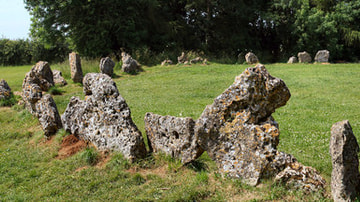
The King's Men, Rollright Stones
Part of the Rollright Stones complex, the King’s Men, a circle of about seventy stones, probably date to c. 2500 BCE.

Definition
Clava Cairns - Monuments to Memory and More
Clava Cairns is an early Bronze Age site in Scotland, located east of the city of Inverness, consisting of three well-preserved cairns (two of which are passage graves) and a number of free-standing stones...

Image
Battle of Stones River
Battle of Stone River, lithographic print by Kurz & Allison, c. 1891. The Battle of Stones River (misspelled here in the print), otherwise known as the Second Battle of Murfreesboro, was an American Civil War engagement...

Image
King Stone, Rollright Stones
Part of the Rollright Stones complex, the King Stone is a solitary weathered monolith dated to 2nd millennium BCE.
Image
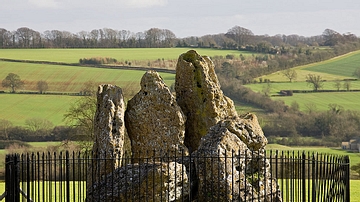
Whispering Knights, Rollright Stones
Part of the Rollright Stones complex, the Whispering Knights, the remains of the burial chamber of a Middle to Late Neolithic portal dolmen, are estimated to date to between 3800 and 3000 BCE.

Article
Dolmens of Ancient Korea
Dolmens (in Korean: koindol or chisongmyo) are simple structures made of monolithic stones erected during the late Neolithic period or Korean Bronze Age (1st millennium BCE). In ancient Korea they appear most often near...

Definition
Dolmen
A dolmen is a megalithic structure typically formed from a large horizontal stone slab resting on two or more upright slabs. The oldest European examples are found in Brittany, northern France, and date to the 5th millennium BCE. Dolmens...

Image
Vishap Stones at Metsamor, Armenia
These Vishap stones (or "Vishapakar" in Armenian) date from prehistoric times and sit just beside the Metsamor Historical-Archaeological Museum-Reserve in Taronik, Armenia. Vishap stones or "serpent stones" are...
Image
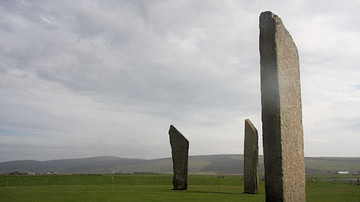
Standing Stones of Stenness (Illustration)
The so-called Standing Stones of Stenness is a Neolithic monument on the island of Orkney, Britain. The four standing stones (each about 300 mm thick and measuring up to 5 m tall) were once part of a massive...
