
Search
Did you mean: Serf?
Remove Ads
Advertisement
Search Results

Article
12 Key Women in Revolutionary Russia
Women were involved in all aspects of the Russian Revolutions of 1905 and 1917 when radical socialists and other sections of society challenged the authoritarian rule of Tsar Nicholas II (reign 1894-1917). As writers...
Image
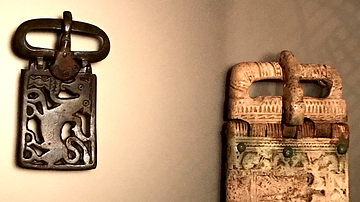
Alemanni Belt Buckles
These Alemanni belt buckles are made from elk antlers and bronze. They date from the 6th or 7th century CE and come from a cemetery in Kallnach-Bergweg, which is located in Canton Bern, Switzerland. (Landesmuseum, Zürich.)

Image
Sitting Bull and Family 1881/1882
Sioux Chief and Holy Man Siting Bull and Family, Fort Randall, 1882 Rear (left to right) Good-Feather-Woman (sister), Walks-Looking (daughter); front (left to right) Her-Holy-Door (mother), Sitting Bull, Many-Horses...

Image
Repaired Greek Cup
A 5th century BCE drinking cup (kylix) from Attica which was imported and then repaired using gold by Celtic craftworkers. (Historisches Museum, Bern)

Image
Celtic Parade Helmet
A Celtic parade helmet in bronze and iron covered in gold with coral inlay, c. 350 BCE. Found buried in a cave in Agris, western France. It is a fine example of the use of vegetal motifs in ancient Celtic art. (Bernisches...

Image
Arrival of the Gypsies in Berne
An illustration depicting the arrival of gypsies (Romani) in Bern, modern-day Switzerland. From the late 15th-century chronicle Spiezer Schilling by the Swiss author Diebold Schilling the Elder (c. 1436–1486).
Image
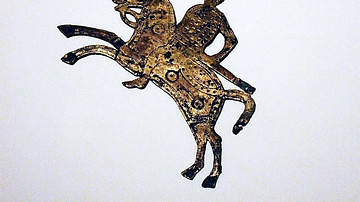
Lombard Horseman Shield Mount
Lombard Horseman Shield Mount from an elite burial in Stabio (Ticino), gilded sheet bronze, now in Historical Museum of Bern.

Image
Golden Shoes of Hochdorf
A pair of thin, embossed gold coverings, which decorated the shoes of the chieftain buried at Hochdorf around 530 BCE. Bern Historical Museum, Switzerland. The burial mound at Hochdorf is associated with the Hallstatt...
Image
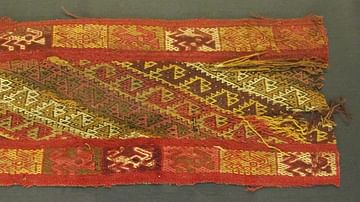
Textile Fragment, Pachacamac
A textile fragment from a tomb at the sacred Andean site of Pachacamac, south of Lima. (Historisches Museum Bern, Switzerland)

Image
Gundestrup Cauldron
The Gundestrup Cauldron was discovered in a bog in Jutland, Denmark. However, the cauldron includes elements and iconography which derive from Celtic, Thracian, and Asian cultures. The piece is the subject of various interpretations...
