
Search
Did you mean: Merlin?
Remove Ads
Advertisement
Search Results

Image
The Parable of the Rich Fool by Rembrandt
The Parable of the Rich Fool by Rembrandt (1606-1669 CE). (Gemäldegalerie, Berlin)

Image
Charles the Bold, Duke of Burgundy
A portrait of Charles the Bold, Duke of Burgundy (1433 - 1477 CE) by Rogier van der Weyden (c. 1400 - 1464 CE). Oil painting. c. 1454-1460. 49 cm (19.2 in) x 32 cm (12.5 in). Now in the collection of the Gemäldegalerie...
Image
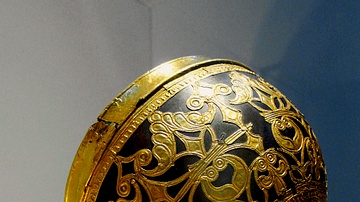
Celtic Bowl, Schwarzenbach Burial
A Celtic bowl with embossed gold leaf decoration from the princely burial at Schwarzenbach, Rhineland, Germany. 5th century BCE. (Staatliche Museen zu Berlin)
Image
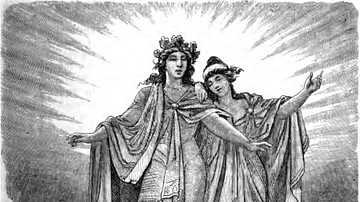
Baldr and Nanna
The Norse god Baldr and his wife Nanna, illustration from page 271 of Nordisch-germanische Götter und Helden by Wilhelm Wägner, Otto Spamer, Leipzig & Berlin, 1882. Baldr was a beloved son of Odin and Frigg. Despite being universally...

Image
Athena from the Library of Pergamon
A statue of the Greek goddess Athena from the Library of Pergamon. 200-150 BCE. Height: 310.5 cm. (Pergamon Museum, Berlin)

Image
Hannah Giving Her Son Samuel to the Priest
Hannah Giving Her Son Samuel to the Priest, oil on canvas by Jan Victors, 1645.
Berlin State Museums.

Image
Allied Declaration of Victory After the Battle of Leipzig
Tsar Alexander I of Russia, Emperor Francis I of Austria, and King Frederick William III of Prussia meet after defeating Napoleon at the Battle of Leipzig (16-19 October 1813). Oil on canvas by...

Image
Hydria with a Harpy
Hydria with a harpy. From Vulci, Italy, dated to the 530-500 BCE. In Greek mythology, a harpy was a part-bird, part-woman monster. In earlier accounts, harpies were described as beautiful young women with wings who personified...

Image
Norns
The Norns Urd, Verdandi, and Skuld, beneath the world tree Yggdrasil. Illustration by Ludwig Burger from page 231 of Nordisch-germanische Götter und Helden by Wilhelm Wägner and Jakob Nover, Otto Spamer, Leipzig & Berlin, 1882.
Image
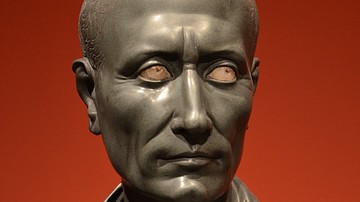
Posthumous bust of Caesar
The so-called Green Caesar, a posthumous bust showing Julius Caesar as a statesman dressed in a toga. Being idealised in contrast to earlier Caesar portraits, this portrait was adapted to the taste of the early Imperial...
